A Weekend in Erymanthia
Date: July 24, 2026
Region: Michas & Kalogria, Achaia & Elis, Peloponnese, Greece.
Partners: Solo
Overview
Erymanthos (2,223m) [P-1200] [”Ερύμανθος”] is the lowest of the four 2000er’s of the Peloponnese, and is situated in the West, close to the city of Patras (”Πάτρα”). Unlike many mountains in the Peloponnese, Erymanthos (2,223m) is wildly underdeveloped, and looking at a rapidly declining population, making it feel especially remote and untouched. Guide authors describe it as a massif isolated and stoic, standing as a lonely and little understood guardian above Achaia[1]. Settlements are at low elevations, small, and often inhabited only during the summer, making for a very interesting proposition compared to nearby massifs. Our plan would be to combine hiking to the rocky summit of Olonos (2,223m) [”Ωλονός”] with some rock-climbing at nearby Kalogria (”Καλόγρια”) beach, and general exploration of the broader area.
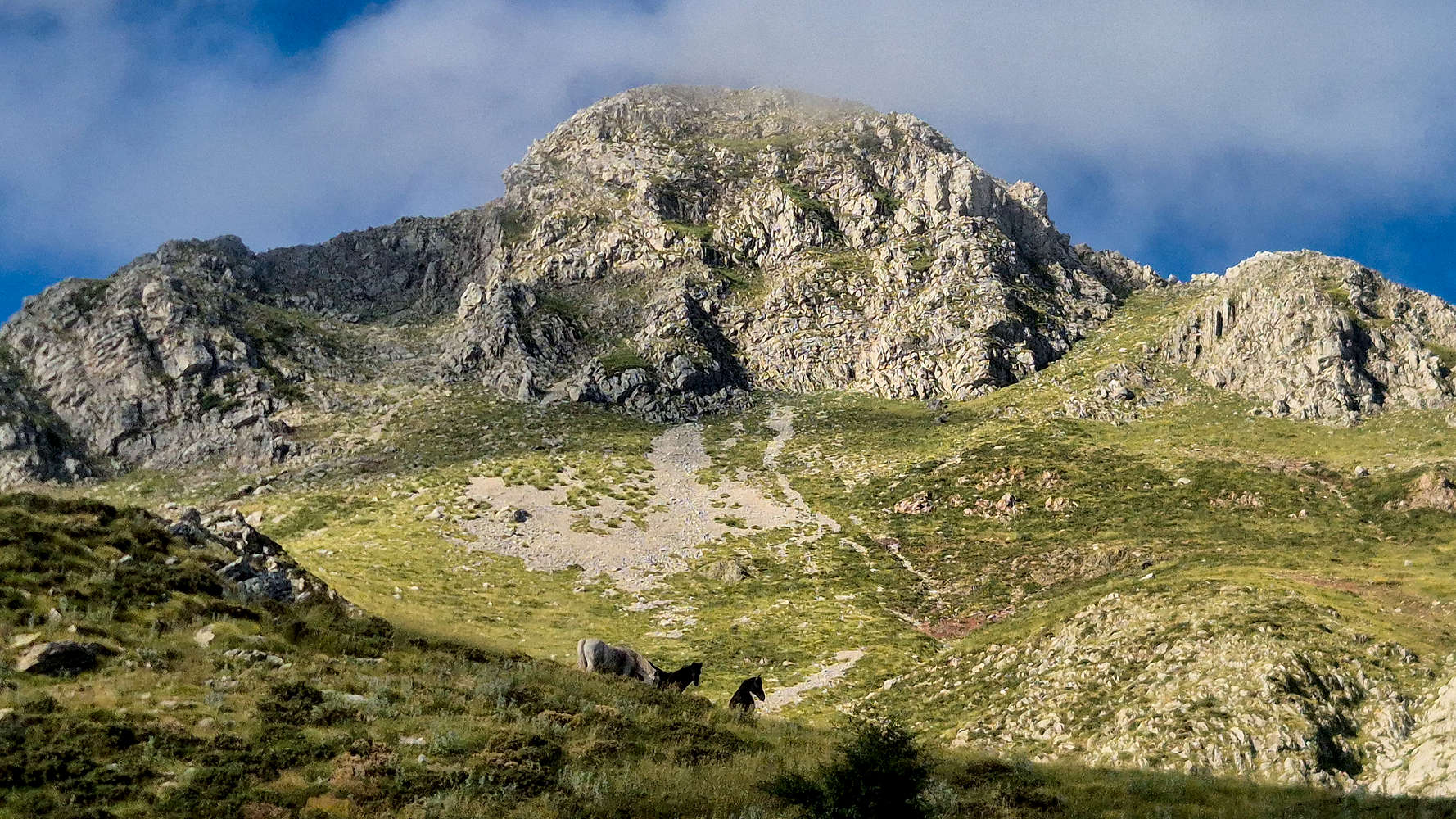
Horses below Megali Mouggila (2,169m).

Climbing above Prokopos Lagoon.
The trip would begin in Athens, but take us straight to the village of Michas (”Μίχας”) where we would enjoy the mountain environment before making our attempt on Olonos (2,223m) the next morning, having little to no plans for the rest of the day. On Sunday, we would leave the mountains and head to the sea where we would climb above a lagoon and enjoy some cold beers by the sea before returning home. Inspired maybe in part by the ancient Greeks and their perception of the mountain as a wild realm, one of paradox, inversion, and perhaps a little magical, we looked forward to explore its lands, and maybe meet some of its paradoxes[2]. Little did we know, that like the author of the following Hellenistic epigram, Erymanthos (2,223m) would serve as the perfect setting to digest major changes.
“I am no longer mad for boys, as I was before; now I am now called mad for women; now my discus has become a rattle. Instead of the unadulterated complexion of boys, I now take pleasure from skin covered in chalk, and from the adorning blossom of rouge. Tree-crowned Erymanthos will be a feeding place for dolphins, and the wave of the grey sea for swift deer!” — Unknown Author, Greek Anthology 5.19.
Interactive Map
Friday — Arrival
We left Athens just after 18:00, and drove South through the Friday traffic onto Megara (”Μέγαρα”) where we encountered a massive weather system. For about 20 minutes we drove under a blasting (literally) tropical rain with high winds and less than 10m of visibility. While the worst was overcome quickly, the rain persisted, even under clear skies, but around Akrata (”Ακράτα”) we were served with a beautiful rainbow strewn across the Gulf of Corinth; I couldn’t help but smoke under the drizzle, enjoying the view.

Cloudless rain past Corinth.

A fiery sunset above Patras.
The weather was nearly as confused as I was once we neared Patras, turning its back on the rain and instead providing the perfect canvas for a fiery sunset. Along the deep contrast of the orange and red, the mass of Varasova (914m) [”Βαράσοβα”], Erymanthos (2,223m), and the Ionian Sea, all played their part in this moving composition; which could only be completed with the melodic voice of Zach Bryan.
Dinner at Michas
Arriving at the village of Michas-Tsapournia (”Μίχας-Τσαπουρνιά”) at 21:30 we went straight to Zachariakis Hotel (⭐4.9 | +200) to check-in and have dinner. For which we selected easy to digest dishes since we would be up in less than 8 hours. Everything was excellent and prepared quickly, including off-menu plain pasta for Terry. After our dinner, a table of locals invited us over, seeing us in all our gear, and gave us some information on the mountain and route. They mentioned that we may run into Tasos at Roumeliotiko spring, and if so we should stay for cheese and Tsipouro.
Talking to Mrs. Georgia
After dinner I took my usual night-time walk and looking for somewhere to sit, I ran into Mrs. Georgia (”Γεωργία”) by the Chapel of St. George. Getting to talking I learnt she was one of the first residents of Michas in the 1960s, a time during which the houses of the village were either wooden or earthen, and has seen major changes in this time. The village takes its name from the owner of the land at the time, “Michas”, which “Tsapournia” refers to the Blackthorn (Prunus spinosa) bush. During its peak in the early 70s, Michas hosted multiple hotels, a grocery store, a barber, and a newspaper; today the village is only inhabited during the summer[3]. Even so, Mrs. Georgia has noticed less and less people visiting each year, with many of the businesses and homes now closed. She noted that the Cephalonian Firs (Abies cephalonica) don’t even smell the same anymore.
Seemingly deeply moved by my interest in the mountain she wished us well on our hike the next morning. We discussed a local history book she hoped she could show me the next day, and finally pointed me above the chapel where I could sit at a small summit with a rock; on which there was once a hagiography of Moses. I spent a couple hours up there, smoking as the moon rose within the clouds and the village went to sleep lullabied by the hooting of a Eurasian Scops-Owl (Otus scops). At 12°C the air chilled me to the core but I stayed anyway, thinking about how someone, somewhere understood; and how maybe Zach Bryan was right all along:
Saturday — Erymanthos
A little tired from driving the night prior, we decided to postpone our wake-up time for a about an hour, watching much of the sunrise from the balcony as we got ready.
Erymanthos (2,223m)
Arriving at the trailhead with the cool summer morning still settling around us, we were in for a treat of nearly 8 hours of continuous hiking through some of the most spectacular alpine terrain we have ever experienced. The long and remote ridges and slopes of the mountains were brimming with life, some of it friendly, other a little bit aggressive. Yet, we managed to find our way atop of Olonos (2,223m), and enjoyed the glorious views it offered us.
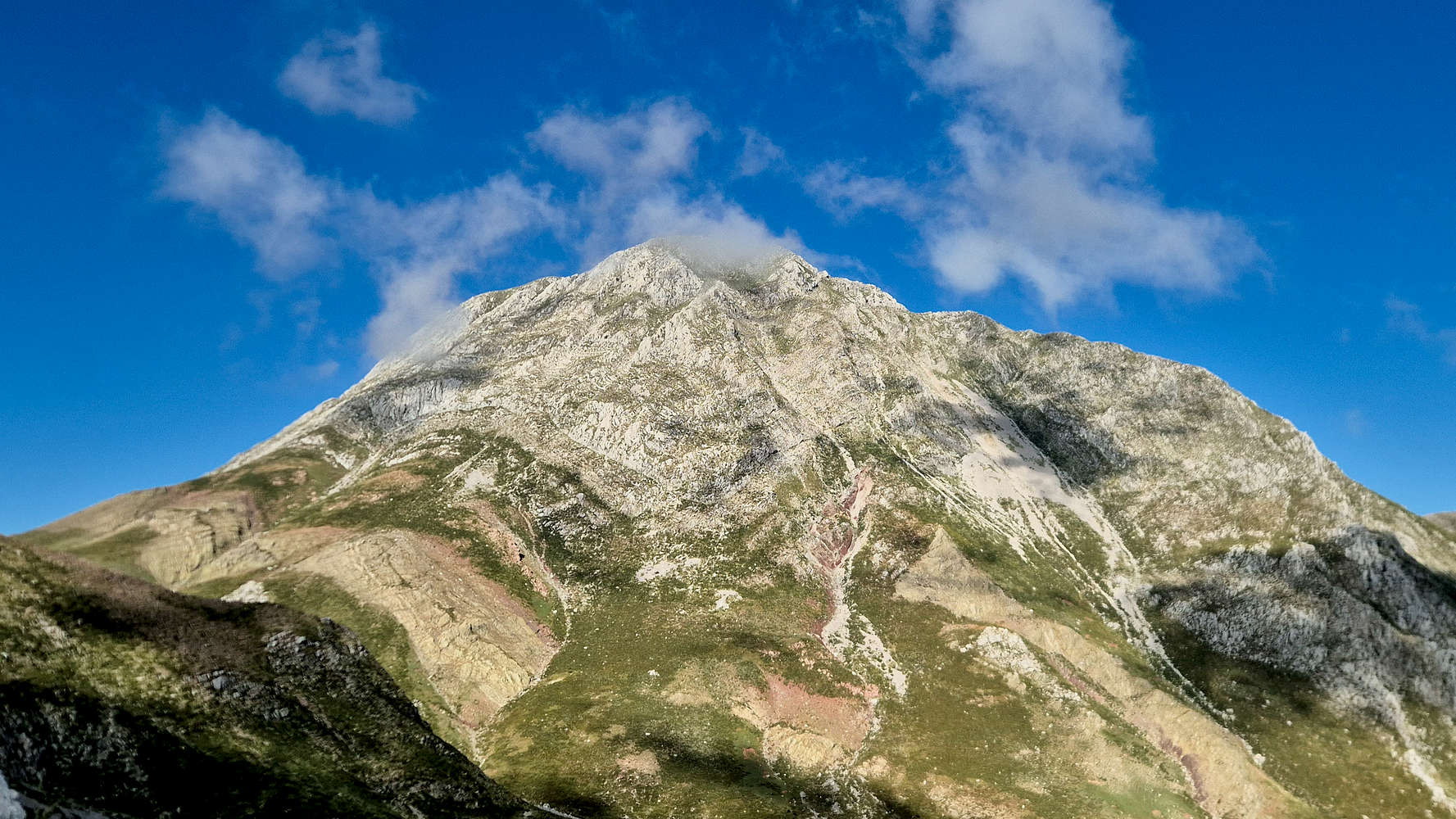
Our descent was one into the local culture, history, and economy, as we got to spend time with the last of the Shepherds, perhaps the last on the entirety of the Peloponnese. Their traditional practices, and resistance to governance, modernity, and comfort brought to the forefront considerations about permanence of practices, traditions, and culture. Do things really fall apart?[4]
“Διψάν οι κάμποι για νερό και τα νερά για χιόνι, διψάει κι ο δόλιος ο Ωλονός για τους παλιούς του κλέφτες;” — Traditional poem
Early Dinner & Bouldering
The Tsipouro really did a number on us, and after a prolonged nap I woke up around 19:30 to have dinner. Feeling better about a large meal we enjoyed a plethora of local delicacies such as Mizithra (”Μυζήθρα”) cheese, a huge Greek salad, and meat mains; Tsipouro was not consumed on this occasion. Feeling somewhat better from the migraine which haunted me since Roumeliotiko I decided to digest my dinner with some climbing on the small “Moses Rock”. Having clambered up the easier backside the night before, I worked a bit on the taller (NNE) side, which offered a lovely V1 arete on good jugs, climbable in running shoes. I went back in for a nap.

Moses Rock at Michas offering some easy climbs.
Reflections
Like some sort of odd vampire I came out in the night, making my way back to the rock; which I found out to be the local cat hangout. I couldn’t help but spend a few more hours up there reflecting on the day, and the shepherds we had met. With whom we are so different, yet so alike, and tonight we are all looking up at the same night sky, and I wonder if they too feel the urge to keep moving, knowing well they can’t go on forever. Yet, persevering against hardship and suffering we are blessed to find happiness in the mundane: cool spring water on a hot summers day, the loving bark of a shepherd dog, the sweet smell of wildflowers on a meadow, a heartfelt conversation between friends, and the cool glow of a moonlit night sky. Who am I, and where am I going? Maybe I’ll close my eyes for a little while and let the Owl’s call put me to sleep.
Sunday — Kalogria Crag & Beach
We left Michas at 06:30am, and drove back down towards Patras with the high peaks of Erymanthos (2,223m) bathed in the golden light of dawn; now, stripped of their mystery I saw them as friends, ones whom I will miss at that. We listened to prog. rock and punk, hyping our exhausted selves for our hot and humid climbing session. We drove non-stop until Sageika (”Σαγαίικα”) on the old National Road where we picked up breakfast from Peri Artou (”Περί.. Άρτου”) bakery. The approach towards Kalogria (”Καλόγρια”) takes one through countless greenhouse plots, and then passes below the Mycenean Dymaean Wall (”Τείχος Δυμαίων”), before arriving at the crag.
Climbing at Kalogria
Parking at the main area (📍Google Maps) at around 08:00, we geared up and hiked the 400m approach to the School (”Σχολείο”) sector of Kalogria Crag; and by 08:15 we were at its base. The idea would be to start on the two FR 4c routes which Terry should be able to climb, before working on some harder ones. However, climbing onto Pseira (4c, 20m), it quickly was obvious this was a major sandbag crag, courtesy of the legend Y. Torelli; who left us too soon.

The right side of the School sector, below Mirmigki (4c, 20m).

Prokopos Lagoon from the wall, fishermen visible.
As such, I made sure to clean most of the route before Terry gave a go of the pre-crux section on top-rope. We did the same thing for Mirmigki (4c, 20m), which was a little easier but featured a technical and slippery crux. The trend continued on Tzitiziki (5a, 20m), and worse yet on Psilos (5a, 20m), with its roof crux (!!) protected by a piton. All routes I climbed were onsight, and required delicate thoughtful movement, but featured great rests and jugs in the easier sections.
View from above the crux of Psilos (5a, 20m).

The crag from the anchors of Mirmigki (4c, 20m).
Nearly at every anchor or good ledge I took some time to enjoy the majestic views of Prokopos Lagoon (”Λιμνοθάλασσα Πρόκοπου”), part of the National Wetlands Kotuchiou - Strofylias (”Εθνικό Πάρκο υγροτόπων Κοτυχίου – Στροφυλιάς”), and on a couple of occasions brought my binoculars up with me, getting to birdwatch from the wall. The crag area itself was great with a large flat belaying area, plenty of shade early in the morning, and exceptional views to the wetlands below. The morning procession of birds included Dalmatian Pelicans (Pelecanus crispus), Great Cormorants (Phalacrocorax carbo), Little Egrets (Egretta garzetta), but unfortunately no Greater Flamingoes (Phoenicopterus roseus). After over 3 hours, and some projecting for Terry on the crux of Mirmigki (4c, 20m), we walked back to the car and headed to the beach as the temperatures rose past 30°C.
Kalogria Beach
Just after 12:00 we arrived at a somewhat busy Kalogria (”Καλόγρια“) beach, just a few kilometers from the crag, and went to sit at Sandhill (⭐4.3 | +1,000). Although opposed to paying to sit at the beach we were already pretty wasted, and the €10 minimum consumption for some shade was well worth it. On this side of the beach the 9km-long sandy shore is replaced with massive sand dunes — some of the biggest in the country[5] — and so I took my time walking around before jumping in for a swim.

”Sandhill” beach on the N side of Kalogria.

The actual sand dune from which the beach is named.
After a little bit of swimming, a couple of cold beers, and some souvlaki which the wasps were very interested in, it was time to shower and head home. While invited to continue climbing all afternoon in Athens, I opted to go home, clean up, and spend some time with Nieve instead. Besides, I soon realized I was rather badly sunburnt. The 3 hour drive, ahead of the usual Sunday traffic, put us back in central Athens around 18:00.

Driving along the gorgeous pines in
Logistics
As a weekend trip in Greece, there was very little logistical planning. On Friday we drove 235km to Michas from Athens, and ate dinner at our hotel — and the only operating tavern. On Saturday we only drove locally to the trailhead before returning to the village. Finally, on Sunday we left Michas early and went to Kalogria for climbing and swimming before returning back to Athens. Since there is a hotel and tavern at Michas, the logistical planning is simplified, however, there is no place to buy groceries.
Ensure that you have brought any snacks, extra foods, or beverages with you as there is no shops in the general area of Michas - Tsapournia.
Zacharakis Hotel
Situated centrally in the settlement of Tsapournia, Zacharakis Hotel & Tavern (⭐4.9 | +200) is the primary accommodation for visitors to the village. It is generally open during Spring - Summer - Autumn, and features relatively new and well kept rooms. Our two bed standard room was large, with a fridge, an adequate bathroom, and both a large balcony with a great view, and a fireplace. For around €60 per night including breakfast (which we did not get to have), it is also good value. The rooms and common areas are all very clean, and the same goes for the kitchen which prepares excellent home made village food, with large portion sizes perfect for hikers.
