Easter in East Pelion
Date: April 9, 2026
Region: Eastern Pelion, Magnesia, Thessaly, Greece
Partners: Solo
Overview
Pelion (1,610m) [P-1473] [”Όρος Πήλιο”] stood out for us as a compelling hiking objective and being known for its natural beauty and traditional Orthodox Easter processions, it was an easy choice for our large group. To accommodate our route of choice for our ascent of the mountain we opted to stay in Eastern Pelion, at the village of Zagora (”Ζαγορά”). Besides being the apple “capital” of Greece, and featuring lush forests driven by Aegean rainfall, Zagora is rather remote, and has poor connectivity to other areas of the very large massif making it a less popular destination compared to villages on the West aspect.
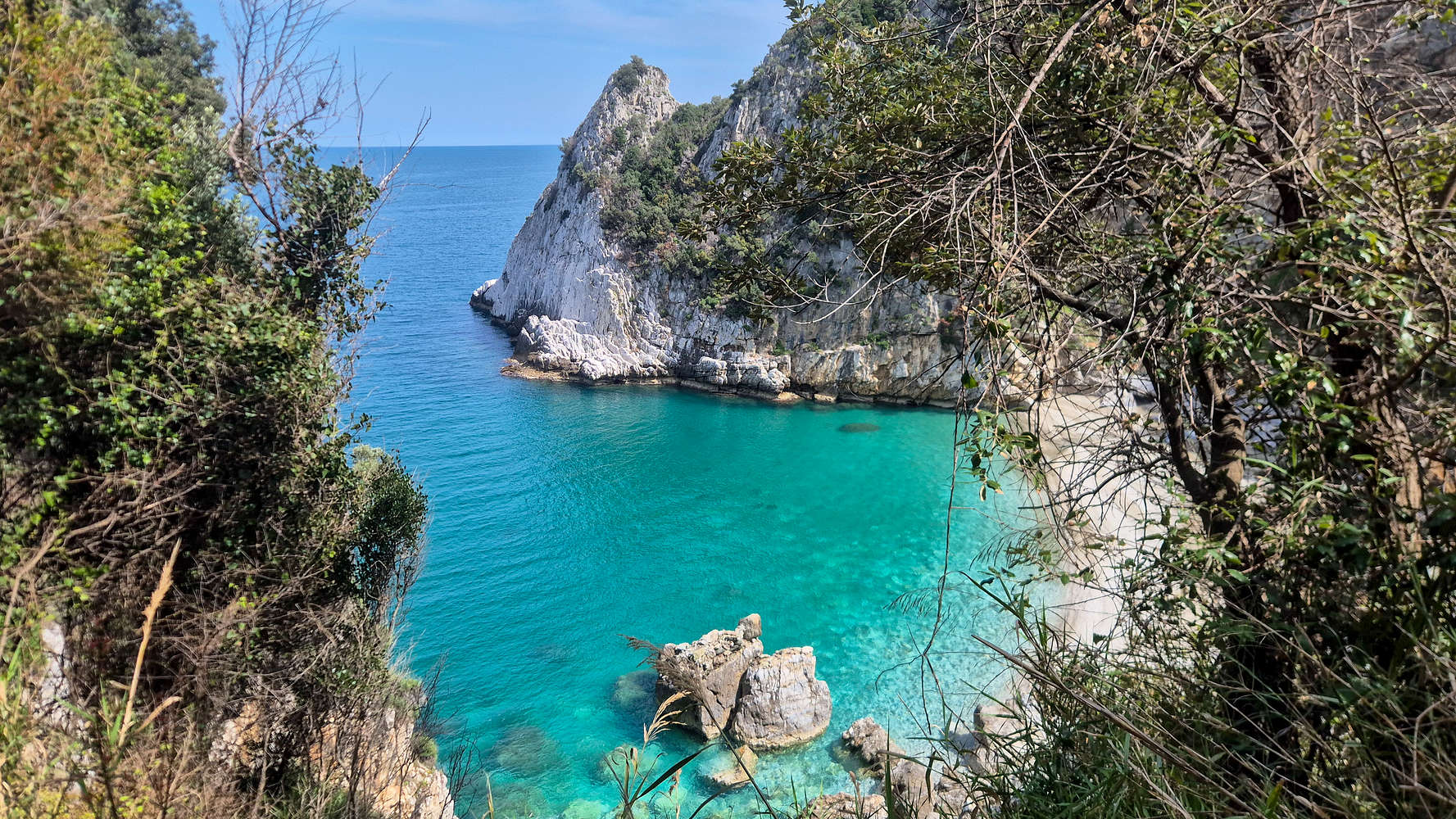
Fakistra beach with its limestone fin.
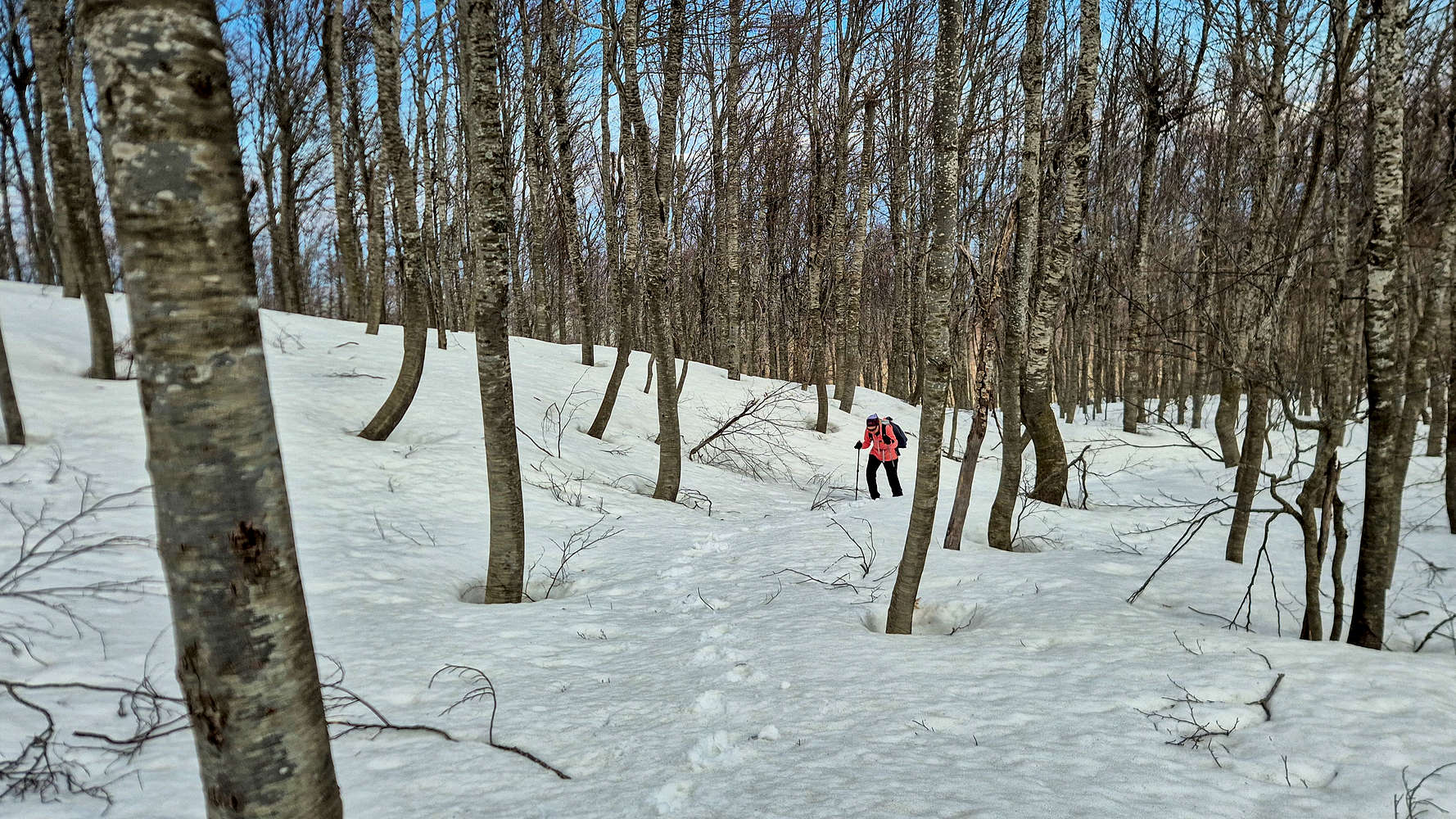
Breaking trail near the summit of Pelion.
Yet the East of Pelion has long been a sort of exclave of power and culture, with the residents of Zagora being significantly involved in maritime trade since at least the 15th Century BCE. Dispersed human settlement, and the realities of life on a steep mountain-side, have precluded the extensive development of tourist sites, including places of cultural, historical, and natural interest. In contrast, lush nature, the primary element of the mountain can be found all around, and for most is best experienced from the margins of civilization. This is because, unlike many other mountains Pelion remains dark and mysterious under the dense canopy, often vailed by fog, and its winding and poorly marked trails can easily confuse any hiker.
Interactive Map
Day 1: Faces of Pelion
Following our late night arrival into Zagora, and our B&B Αρχοντικό Στάμου (⭐4.9 | +300) , we took some time to finally acquaint ourselves with Karolos, and his significant other Katerina, who is the son of a couple of my parents’ close friends, with whom we have previously travelled in 2024 on our successful attempt of Voutsikaki (2,154m) [P-645] near Lake Plastiras in Thessaly. Absorbed in conversation and pleasant company it took us a while to head to bed, forgetting for a while the toils which would perhaps await us tomorrow on our attempt of Pelion (1,610m)
Pelion (1,610m) [P-1473]
The sun was already shinning bright when we took a swift breakfast at 07:30am, and we soon found ourselves on the short drive to the nearby village of Pouri (”Πουρί”). Aris very pleasantly accommodated us with a lift all the way to the narrow village streets. With a broad smile set in front of the glimmering Aegean sea, he bid us farewell, for the next 20km of hiking and 1,300m of gain could hold a lot of surprises; and they certainly held up to that.
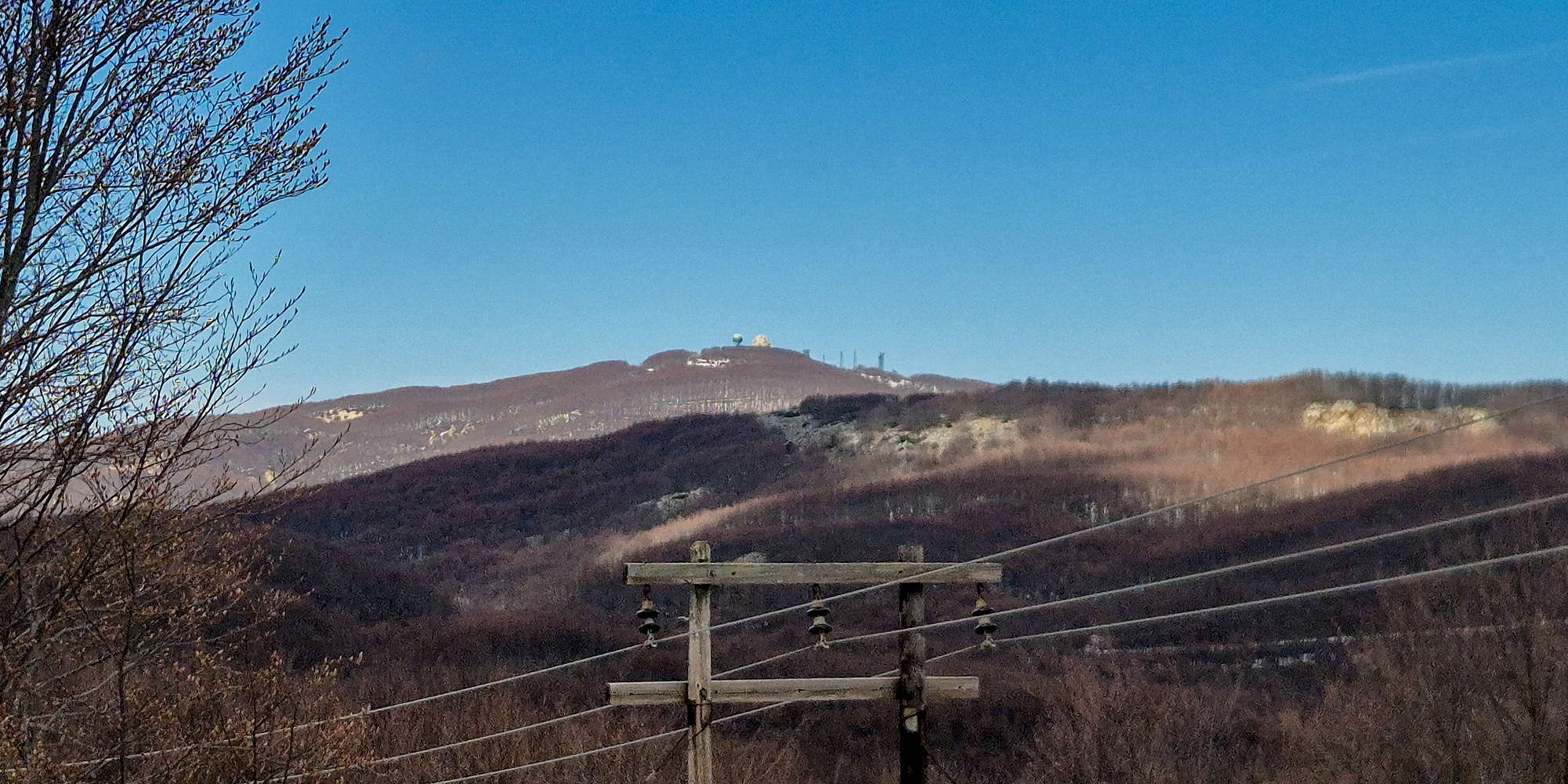
Salvation at Chania
The small settlement of Chania (”Χάνια”) at 1,200m has long served as a welcome stop for weary travelers making their way into remote Eastern Pelion and took its name from the Inns which were once located there. We felt a similar wave of relief arriving there on the back of a pick-up truck after nearly 8 hours of hiking, a freak hailstorm, our arraignment by military police, and a showdown with guard dogs. Needless to say, the exceptional spread which followed at Χάνι του Κοκκίνη (⭐4.7 | +1,000) was enjoyed to the fullest; and calling on the excuse of my ‘traveler ‘ status I allowed myself to dig into a scrumptious portion of grilled sheep ribs on this Easter Friday. As the afternoon settled, we made our way back to Zagora for some rest before the nights’ activities.
Epitaph in Zagora
As is customary on Good Friday, the Epitaph of Jesus is paraded in a solemn procession around the village, before returning to the church where the rites and psalms of the evening are sung. Zagora features a unique tradition on account of it being four (4) different village ‘neighborhoods’ each with its own church. Thus, for the procession, each church adorns in Epitaph a different style, before they meet at the main village church of Agios Georgios (”Αγιος Γέωργιος“). The neighborhood of Perachora (”Περαχώρα”) decorates using Violets, a spring flower, while Agia Kuriaki (”Άγία Κυριακή“) prefers white wildflowers, however, the Epitaphs of Agios Georgios and Transfiguration are much more intricate - undertaking a week-long process of decoration using Spartium and Erica manipuliflora [1].

The three Epitaphs of Zagora at the main square.
Zagora itself is also a very interesting and important village which had long served as the main settlement in Eastern Pelion, with datable remains of the 15th Century. After joining Greece in 1878 as part of the Thessaly Concession, it began to see large outflux of residents, emigrating to the US and Australia; many would make large fortunes and contribute greatly to the development of the village up until the interwar period. In 1916 the Farmer Cooperative of Zagora was founded, but would only thrive after the introduction of the Starking Delicious apple variety from the US in the 1960s. The ‘revolution’ of productivity that followed saw the continuous introduction of more fruits. Today, the cooperative sells up to 15,000 tons of apples per year under the Zagorini brand.
Day 2: Poros Waterfalls
Easter Saturday called for a more relaxed pace as I still recovered from the day before, which ended after midnight on account of the Epitaph. In contrast, Karolos and Katerina were excitedly looking for a possible hike, having opted out of joining us the day before. With the very visible destruction by Storm Daniel, the condition of many of the ravine hikes on the low mountain was questionable. As such, we opted to explore the most popular and easily accessible trail area, the Karavoma Ravine (”Ρέμα Καράβωμα”), where we could find pools, and potentially try to hike to the less popular waterfalls above.
Poros Waterfalls
After parking on the main road to Chania, we set off down the narrow cement FSR under dubious cloud-cover which we would later discover is rather normal for the area. The roads leads quickly into the ‘valley’ and at this time of year offered both excellent views to the numerous waterfalls on the walls across, and of the blooming Cherry tree on the characteristic hairpin bend. It took our group no more than 20 minutes to reach the Poros Waterfall (”Πόρoς”) the most popular of the bunch.
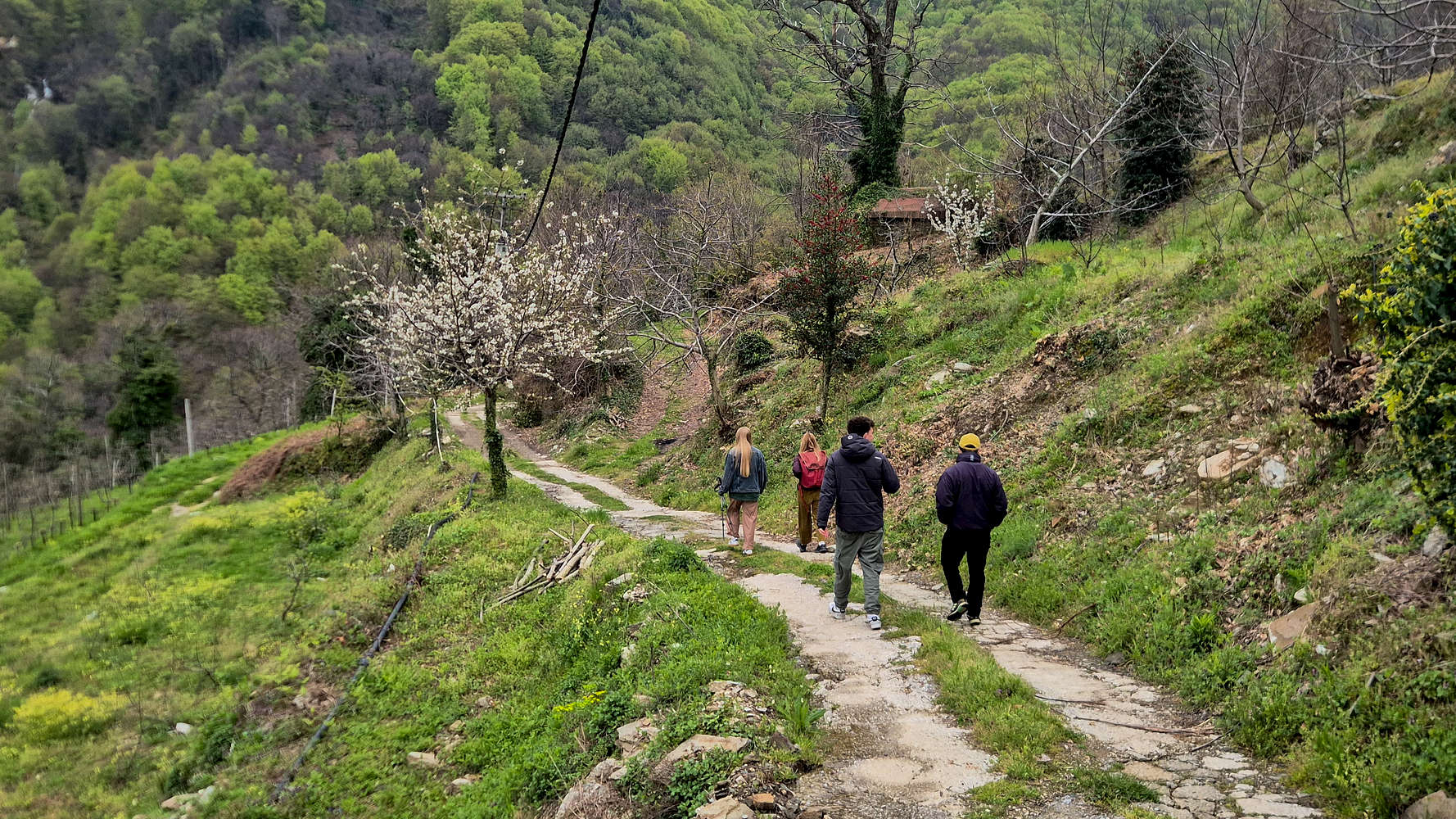
Hiking towards Poros Waterfalls.
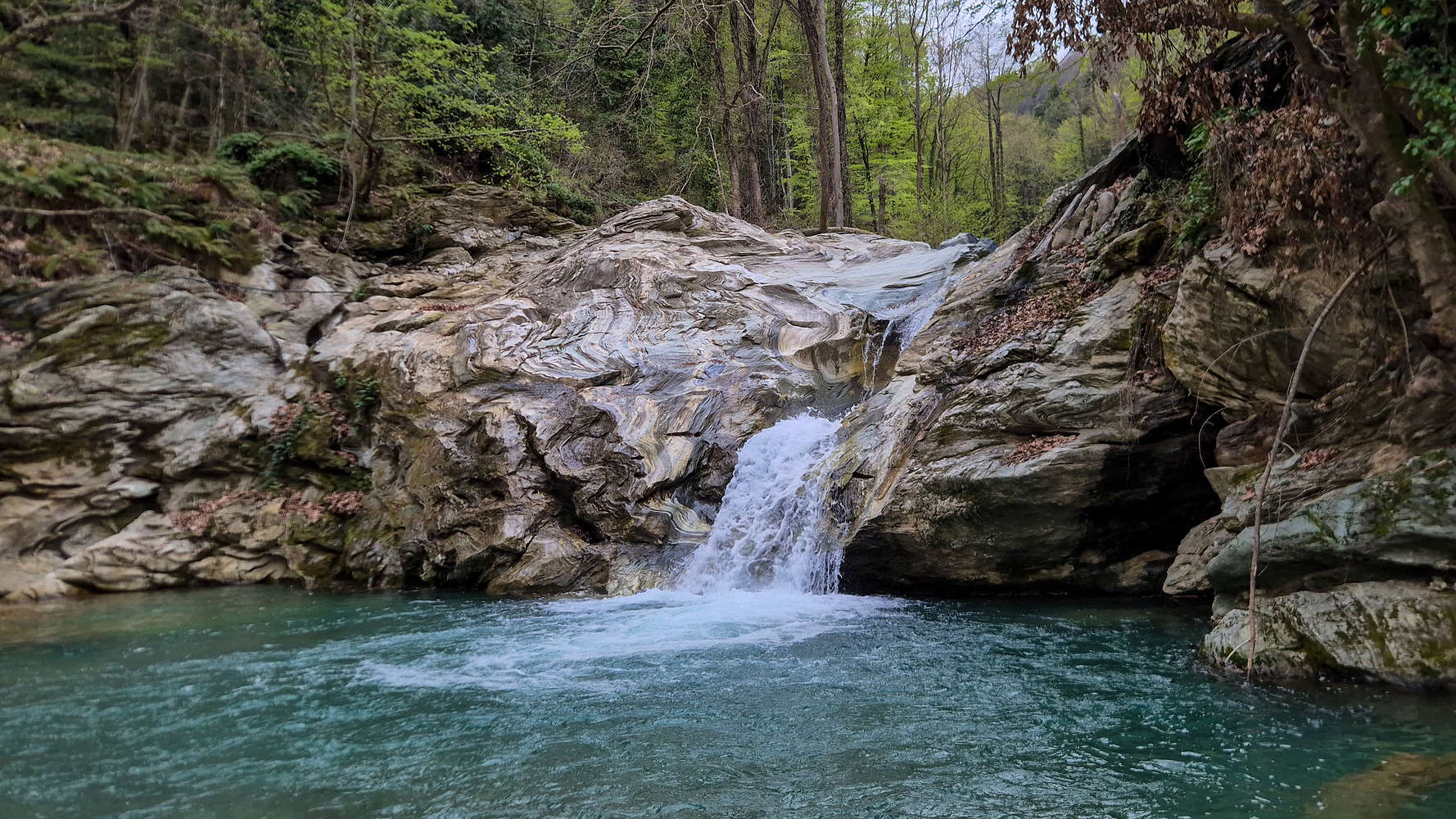
The main Poros Waterfall and pool.
Realizing we could not cross to the other bank easily, and with more people arriving, we retraced our steps and made our way to the upper rung of the waterfall. Here we were able to briefly relax before deciding to continue our ascent. Doing so required a simple, but still sketchy river crossing, which we protected with a fixed rope, and which Nieve ended up freeing. The vague remains of a trail, sometimes completely overgrown or collapsed, permitted little progress. As we approached the former spot of the hanging aqueduct the trail finally ended, the aqueduct itself completely destroyed from the storms of the last few years. We reached our highpoint after 1:30 hours of very relaxed hiking, and proceeded to turn around.

Toe-hook start on the Lonely Boulder Project.
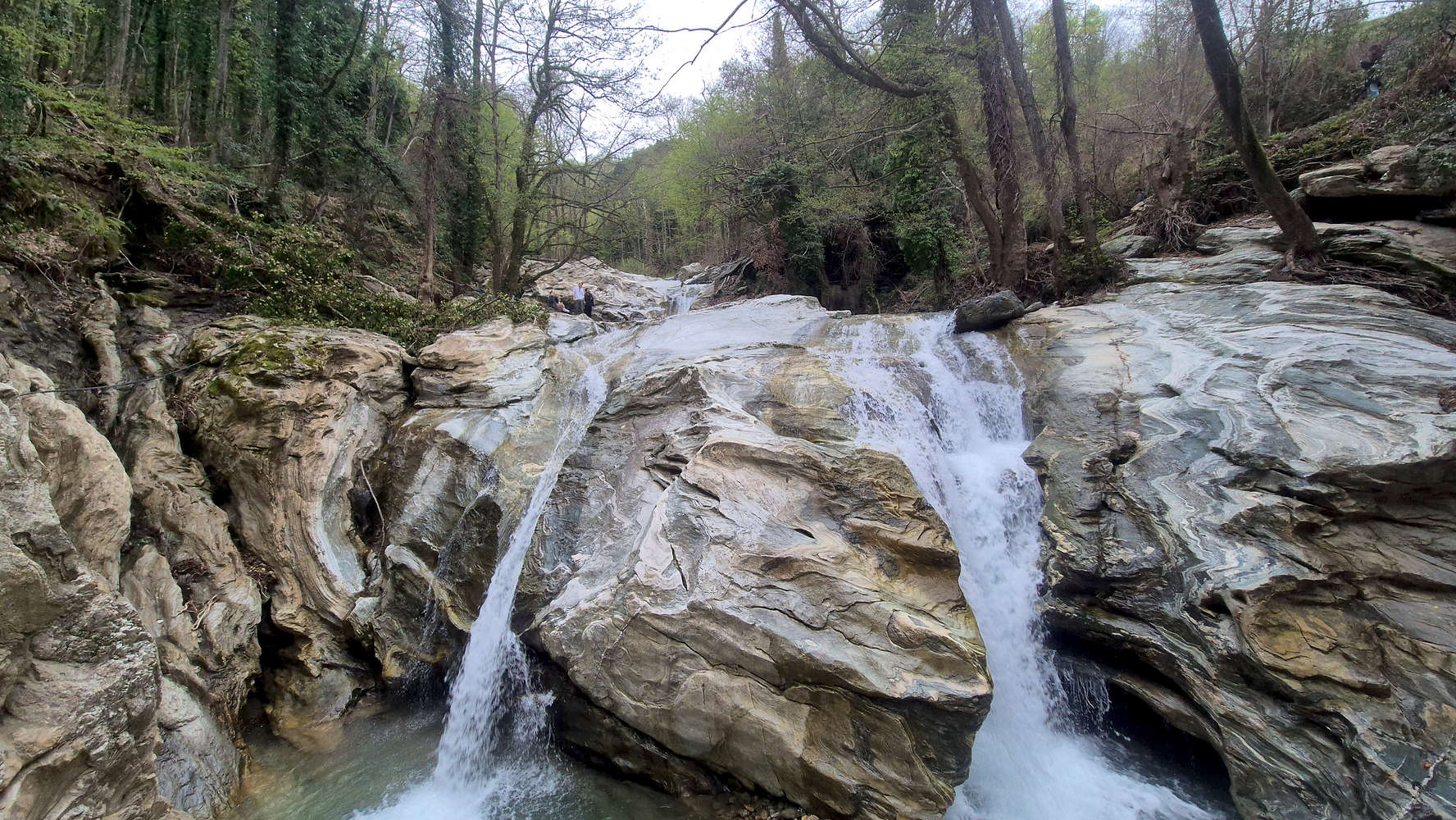
Lower Poros waterfall.
Instead, we decided to settle at a lovely crag, enjoying some easy but steep scrambling, the protection of an overhanging outcrop, and trying a bunch of boulders. Highlight of this was the lonely square boulder, offering an intriguing but difficult line on its overhanging side. After working on its start, Karolos joined in with some VB-V1 grade climbs on a taller boulder nearby while the girls examined the flora and fauna. By this point, we had spent about an hour at this crag and decided it was time to turn around. Doing so, we hiked back, on the ‘wrong’ side of the ravine, all the way until below Poros waterfall. The steep section leading to the lower waterfall offered a surprising arial view, some 10m above the water of a pleasant double fall; not everyone looked over the edge.

Nieve and the cherry blossoms!
After a snack and Raki break at Poros proper, we crossed the quiet but frigid pool and returned to the correct side for our hike back out. Of course, not without being convinced by Karolos to scramble up the old pump-station above the pool. By the time we were ready to leave we had spent nearly another hour, and finally took 25 minutes to gain the 100m of elevation difference to the car.
Lunch in Pouri
Reaching the car at nearly 17:00 we were very much ready to eat some lunch, and with the parents already at Pouri (”Πουρί”), we made a conceited effort to join them as fast as possible. On our drive we caught another glimpse of the magnificent and very large waterfall above Pouri, and by 17:30 were ready to be sat down at Polydroso Tavern (⭐4.6 | +500). Although late to join our families, we still enjoyed a lovely spread of local meze such as sausage, salad, and cheese.
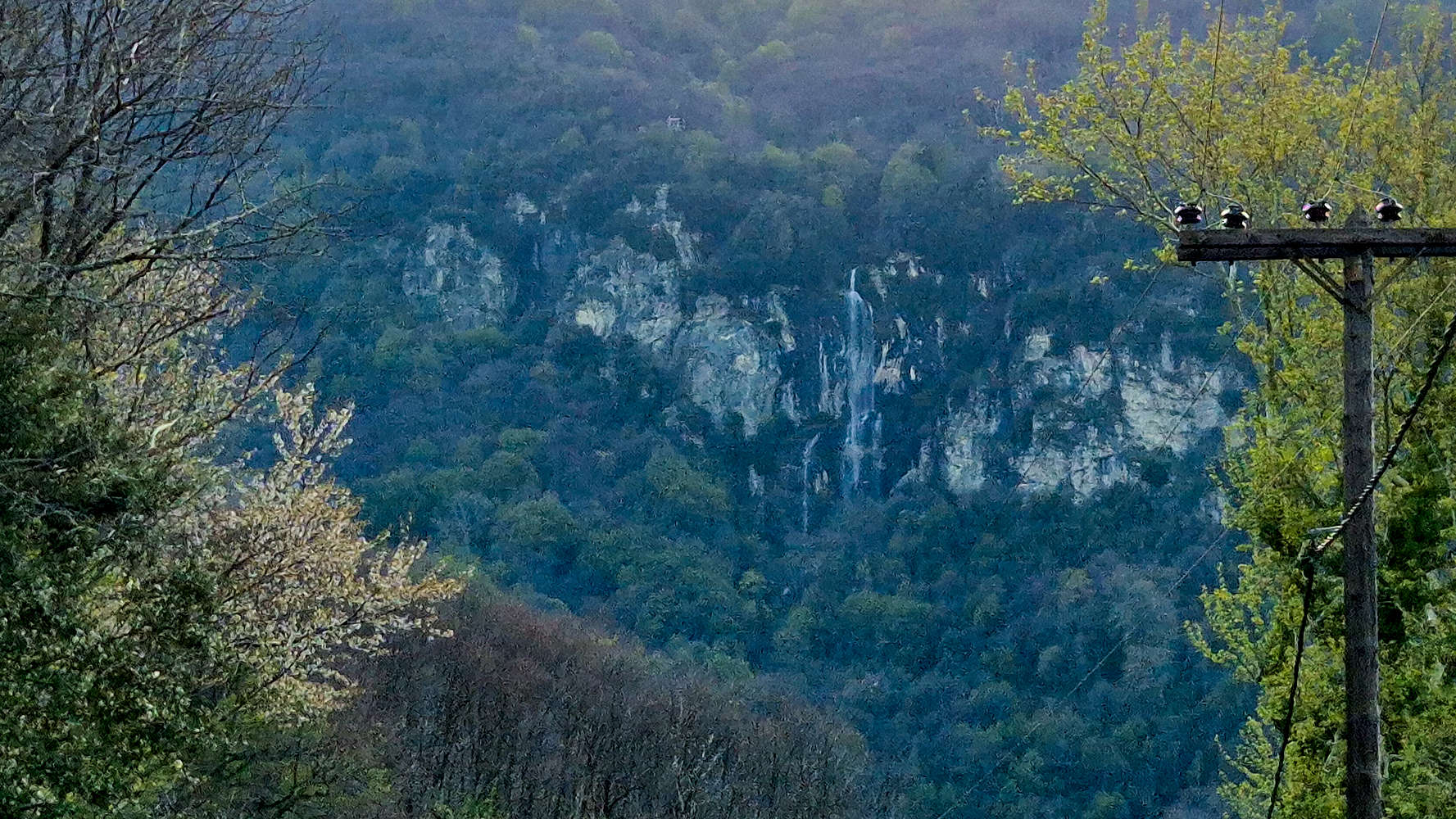
The waterfall above Pouri.
Early Easter Vigil at Choreuto
Given our rather sad and tired state after two very active days, the idea of waiting until midnight for the Orthodox Easter Vigil of the Resurrection (”Ανάσταση”) was wholly unpleasant, especially for Nieve for whom it would be the first time participating in Orthodox Easter. So, when Terry recommended we join her for an early procession at Choreuto (”Χορευτό”) it was easy to agree. The small beach settlement of Choreuto once acted as a hub for the Zagora merchant marine fleet, and today continues the tradition as the region’s primary fishing village. The remote caves and cliffs to the North are notable in history as the site of wreckage for a portion of Xerxes’ I fleet during the First Storm, prior to the Naval Battle of Artemisium (c. 480 BC).

The frescoes of the Chapel of Saint Nicolas at Choreuto.
We arrived at Choreuto just around sunset, and made our way to the newly restored Chapel of Saint Nicolas (”Άγιος Νικόλαος”), a wonderful 17th century beach-side chapel known especially for its spectacular frescoes. The chapel restoration was only completed in July 2025 [2]. Being quite busy inside, I managed to only sneak a single photo before settling outside, where a faint drizzle forced the congregants to gather under the small covered entranceway. By 22:00 we were back at the hotel and ready for bed.
Day 3: East Pelion Beaches
Given that we had spent the last two days exploring the higher elevations of Pelion, it was time to make our way to the beautiful beaches, which with some luck may even offer us a chance to swim. With it being Easter Sunday we were not in any particular rush to leave Zagora, and eventually did so under the usual overcast skies of Eastern Pelion.
Mylopotamos
After nearly an hour of slow and winding driving on the narrow Pelion roads, we finally arrived at Mylopotamos (”Μυλοπόταμος”), perhaps the areas most popular beach, which was luckily basically empty on Easter Sunday. The beach is well known for its combination of fine sand, blue waters, and impressive rock formations such as arches, caves, and roofs, is a renowned tourist destination, but usually features massive swells and strong currents; in our case, it was surprisingly calm.
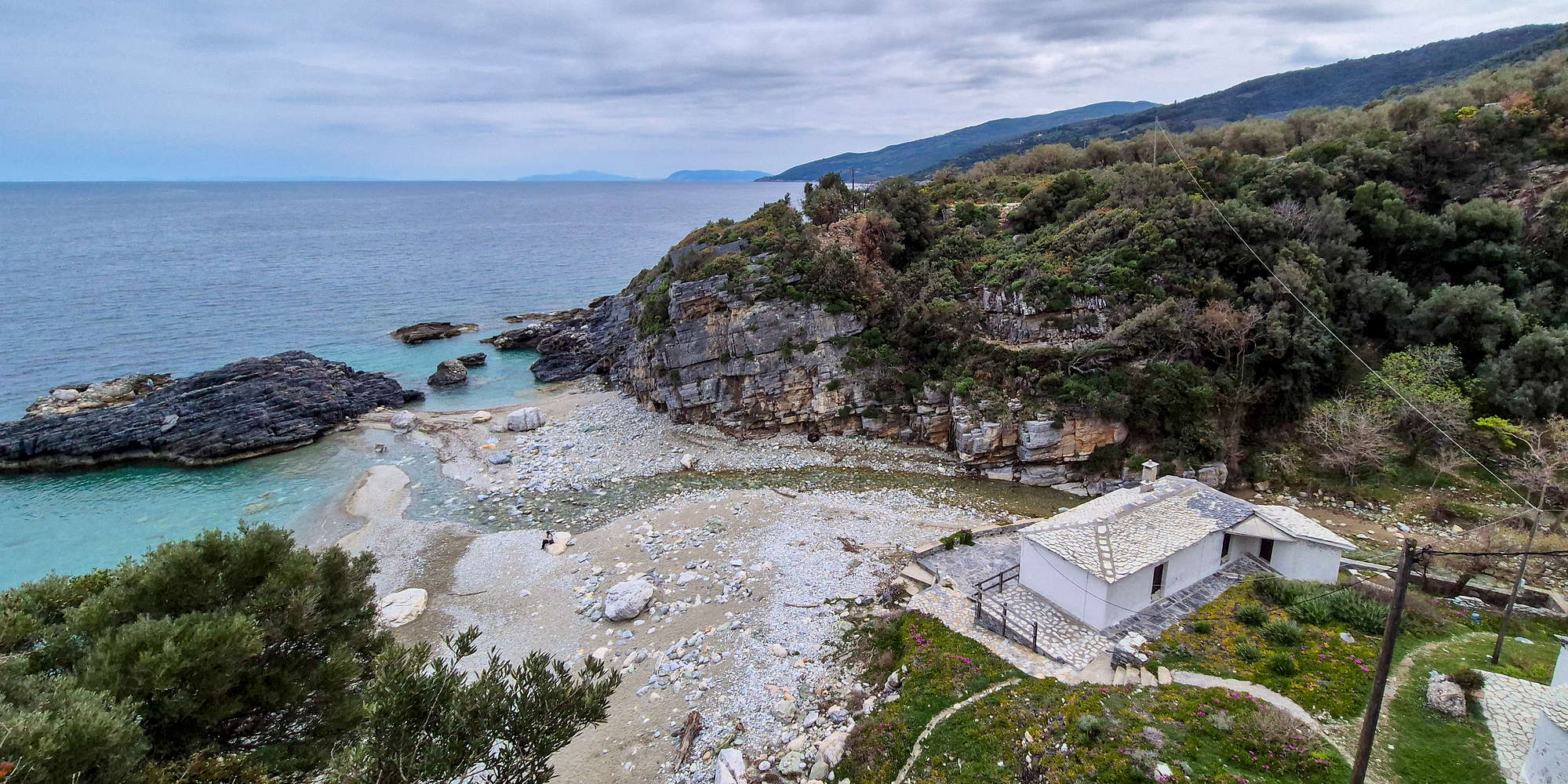
Zodochos Pigi Chapel, and Mylopotamos Sector B.
We walked down the steps to the beach, then turning left continued via the arch into the side-beach, where a large cave can be found. The is where the classic Sport Climbing sector (A) is located, and where to our surprise, we met an older couple from North Macedonia who were climbing the routes. The rusted bolts and fragile rock were not lost on them, with the lead climber placing some traditional protection as well. With us only having climbing shoes, and certainly not braving the bolt condition, we did our best to find some boulders.
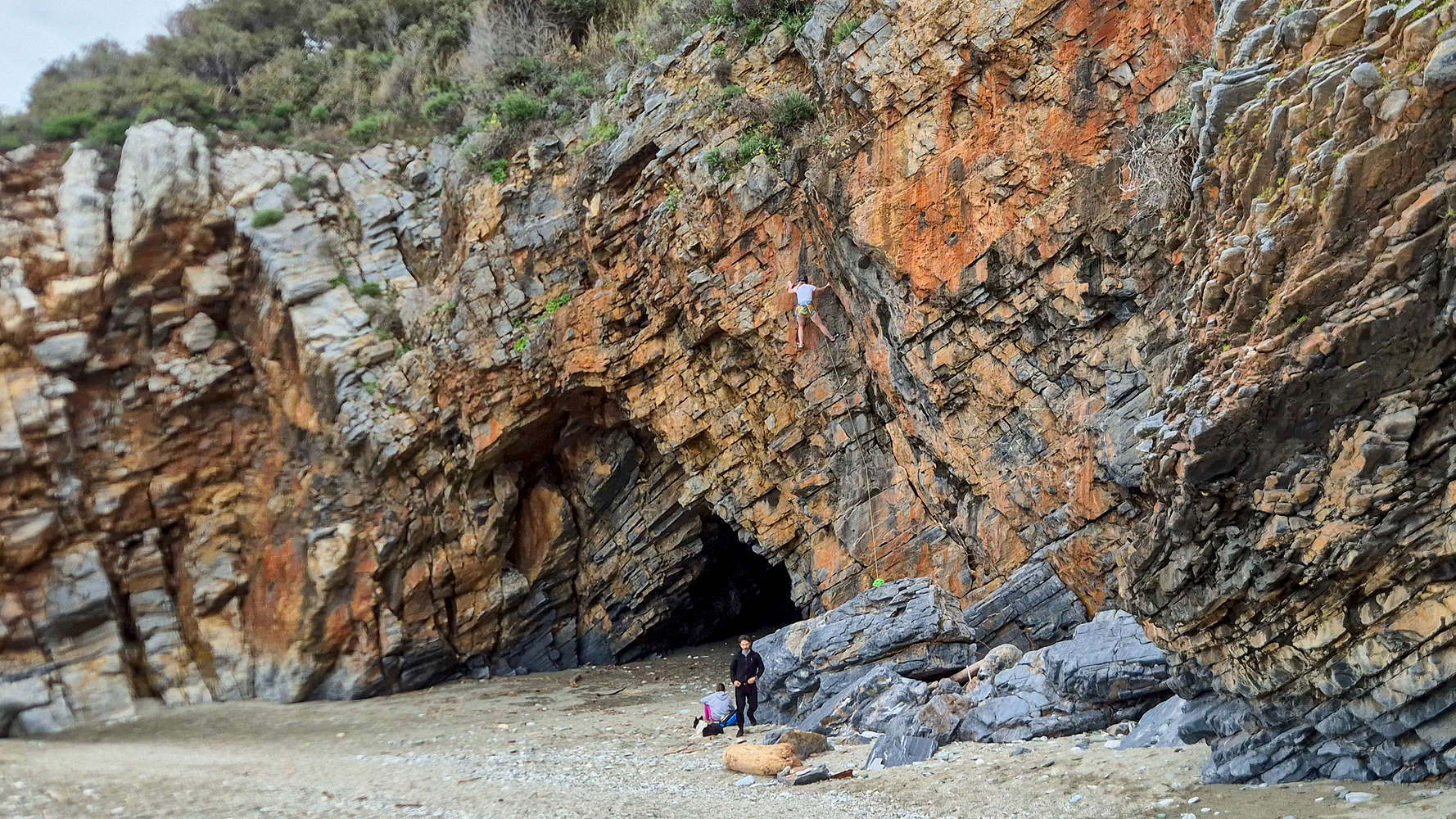
Climbing Modus Vivendi (14m, 6b+) at Mylopotamos.

On our traverse boulder, maybe V1-.
I spent a good 45 minutes trying a series of different possibilities around the beach while the other relaxed by the water, but in the end found myself back at the cave. An easy but wet dihedral slab to its left offered some interest, and so did the featureless side of the entrance arch. Yet the most engaging climbing was within the cave where the characteristic slabs of Schist allowed for easy, juggy overhanging routes; simple and fun enough for everyone including Katerina and Nieve to send!
Fakistra
Feeling good from our visit to Mylopotamos, we took the long way around to reach the nearby beach of Fakistra (”Φακίστρα”), a small rocky cove that can only be reached by foot, approximately 100m of elevation difference. By this time, the sun was shinning and the girls were much happier to be at the beach, even if I was very much engrossed in the availability of rock. The incredible setting of the beach could not be understated either, with high quality limestone, crystal clear waters, and even a waterfall and river flowing out into the sea! The development opportunities for climbs in this area is rather exceptional, and I was able to enjoy a number of boulders of various grades, with and without climbing shoes.
Fakistra beach seen from the trail.

The high heel-hook on Unnamed Project.
Most enjoyable certainly was the Unnamed Project which is a difficult two move roof-escape off a very low set boulder. Requiring a core-heavy start, cutting of feet, and a transition into a difficult high heel-hook, it remains unclimbed. Another standout is the weird conglomerate Graffiti Boulder (V1) which can feel rather pumpy without climbing shoes, although it follows an obvious line of jugs into a high-foot traverse move for an easy top-out. The large polished white-limestone boulder in the center of the beach, offers some heady faux-highball lines on its NE aspect (front), and we instead opted for a very easy ascent on its backside, possible without any shoes (VB). Although the rest of the group enjoyed a brief swim, my aversion to cold water kept me from attempting any Deep Water Solo lines, of which there are plenty.

Climbing Graffiti Boulder (V1), starts in the crack by my feet.

Nieve hiking back to the car.
Having spent over an hour at the beach, and risking being woefully late to our family Easter lunch, we made our way back out the manicured access trail, which although steep, goes by rather quickly. The 100m or so of elevation difference require less than 10 minutes for an average healthy person, and offer a final opportunity to bask in the sheer beauty of this cove.
Easter Lunch
We were in fact terribly, almost an hour, and by then a great portion of the meats ordered — as traditionally done for Easter lunch — were already eaten. Still we made the best of it, re-upping on some ribs and drinking quite a bit of wine and tsipouro. We were delighted with both the variety and quality of the food prepared at Meintani (⭐4.5 | +1,500) for the occasion, even though eating out on such a day is not really preferred. Later that evening, still rather hungry, we also got some lovely pizzas from Ilien (⭐4.6 | +900) for the second night during this trip.
Day 4: Bouldering at Parisaina
Monday, the final of the Eater bank holidays, would be the last day of the trip for Karolos and Katerina, who planned to make the 5 hour drive back to Athens around lunch time (16:00). As such, the plan quickly settled onto doing something nearby, with Karolos and myself angling at least for a beach we could try to boulder at. After a long breakfast and some packing, we headed off to Parisaina Beach, a quainter cove just besides Choreuto.
Getting to Parisaina Beach
Although the simplest way to reach Parisaina from Zagora is via Choreuto, the meanders of access roads often confuse Google Maps, and in the morning rush, we blindly followed it, entering a characteristically Pelion section of road, some dirt and some cement, requiring us to walk along the car. After a toilsome 20 minutes, we reached the tiny parking area for the Parisaina beach bar, which was closed, and hiked for another 10 minutes down some 100m of elevation. Passing through the bar and onto the beach, we met a cute orange cat who begged for food, and after giving it some and constructing a makeshift water-bowl, it just walked off towards some campers and a nearby spring.
Beachside Bouldering
We were near immediately drawn to the Northern end of the beach, where a small outcrop could be seen and settling under its shade, we each made the best of it, the girls started sunbathing, Karolos went for a long swim, and I scouted the rocky area further north for some boulders. After a short inspection walk, I found a number of interesting and varying difficulty boulders, including some more committing lines on the small sea-side cliff, although certainly too polished to be safe. Noting some easy ideas to return to, I joined the rest of the group by the original outcrop.
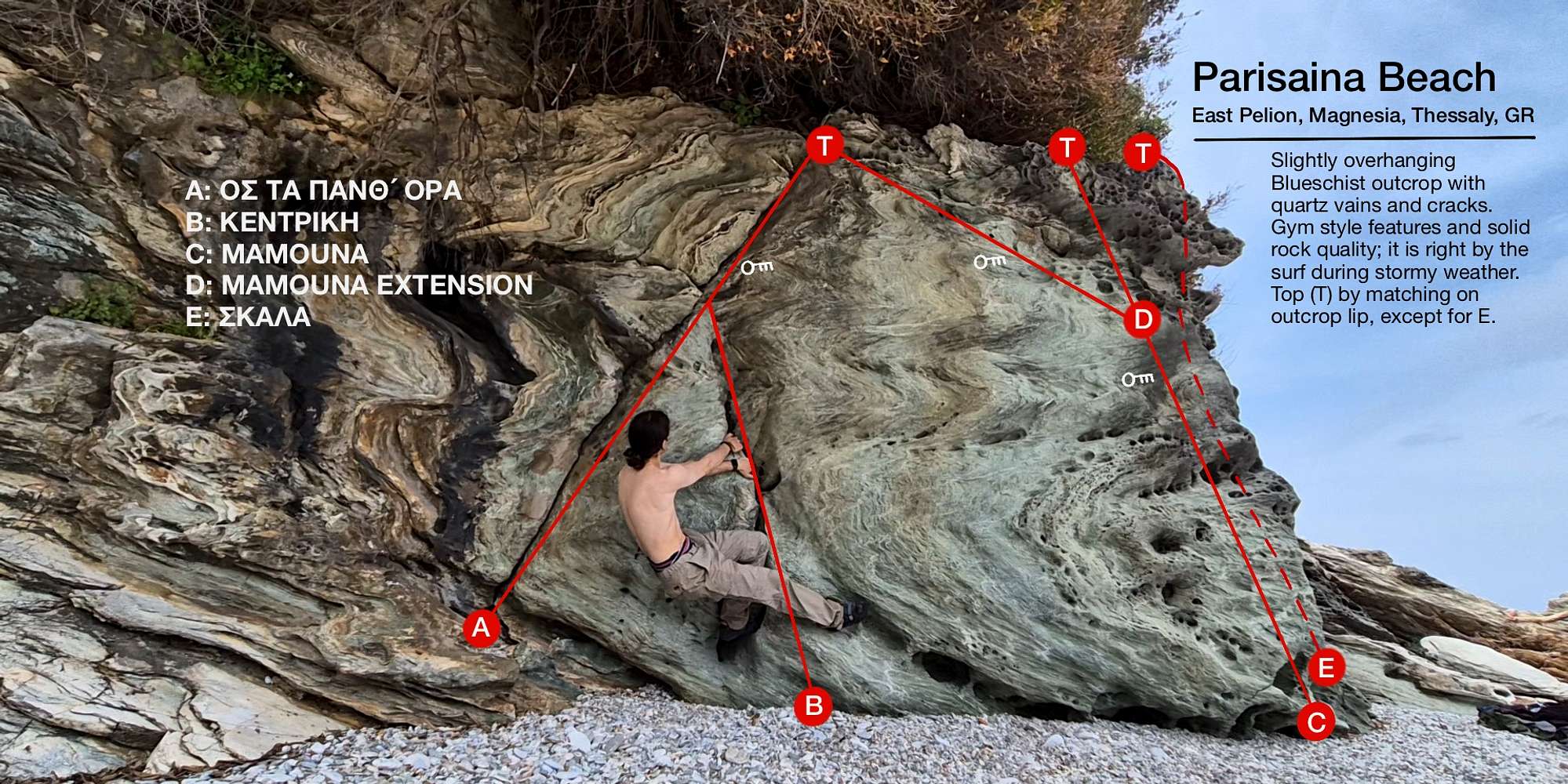
Parisaina Beach Bouldering Topo.
The 3m tall Blueschist outcrop found at Parisaina, is slightly overhanging and very robust, and as we would discover offered very compelling lines. The sea-side arete draw my attention instantly, and after some inspection, a gym-style line, starting in the large holes and continuing on the blank face using amazing edges and crimps, made itself known. As such, this route, “Mamouna” (V1) takes its name from my home gym, and on account of its thumb-crimp, gym style, high-step and dynamic finish. Its extension (V2), going left to the top of the main crack, requires delicate footwork on small edges, and solidified the naming selection since Karolos exclaimed that “[I] look like a spider”. The central crack was next, and following inspection, as well as several of attempts, first working on the left edge crux, and then on optimizing the finish, it went clean. Aesthetic, obvious, and with a feeling of technicality which combines static movement with liebacking, “Central” (V2) was an instant hit, and took Karolos quite a few attempts, culminating in using a drop-knee to reach the crux. Finally, the obvious alternate start on the left crack remained unexplored, but took only a mere four (4) attempts to dial and send; the route “Ος τα Πανθ’ Ορα” (V2) is named after the slogan of the 9th Control and Warning Squadron stationed at the Pelion radars, and who arraigned us on Friday.

Karolos scrambling the sea-side slabs.
Before leaving, we also tried to try a few more fun boulders and climbs, among these was a very simple inclined slab, the nearby and very characteristic ‘shell’ boulder, and a wet dihedral just behind the rocks. However, the most enjoyable perhaps, was the easy (III) scrambling required on some very clear ‘ridges’ of the sea-side slabs, and which we in fact lapped a couple of times. Benefiting from shade, it was a pleasant and athletic outing, and we greatly benefited from the time of year as we were almost alone bar some campers. Slightly late as per usual, we made the long exit hike requiring a good 20 minutes, and we settled in the car, luckily being able to quickly make our way to Choreuto; if only we had gone that way in the morning. Alas, we returned to the hotel and Karolos and Katerina set off on the long drive back to Athens.
Dinner with Nieve
Being woefully late to reach the ongoing dinner at Chania, we opted instead to stay in Zagora, and eat locally. With the parents having eaten in Chania, Karolos and Katerina on the road, we would conclude our trip with a romantic dinner, just Nieve and myself. We chose to go back to Meintani (⭐4.5 | +1,500) since we really enjoyed the meal the day before, but this time we instead chose to order seafood. With expansive views across the Aegean Sea, and under the soft afternoon light, we enjoyed another excellent meal before going back to the hotel to prepare for our departure the next morning. Funnily enough we ran into Nikos D., a mountain guide from Crete whom I was hoping to talk to for a potential upcoming visit in October.

A half-eaten spread of Meze at Marathia, Zagora.
Day 5: Return to Athens
I had taken Tuesday off seeking to have a chill return back to daily life, and with our preference for arriving home early to have enough time to get reorganized, there would not be time for any activities. By the time we woke up, ate breakfast, and packed to leave it was around 11:00, and the drive to Athens takes nearly 5 hours. We planned to perhaps make a quick stop at Makrinitsa, given that it might be much less busy on the first workday after Easter. Yet, we were met with a long line of cars and absolutely no parking space, and thus, having wasted nearly 30 minutes, we drove the long return to Athens.

Volos as seen from Pelion on the return.
Logistics
With Zagora being situated in Magnesia, Thessaly, far north of Athens, we left on Thursday directly after work, and drove for around 5 hours, arriving at approximately 22:00. We had a wonderful stay at Αρχονικό Στάμου in central Zagora throughout the trip. The village itself is large and has many amenities such as shops, restaurants, hotels, gas stations, and pharmacies. Staying that close to the center of the village allowed us easy access to one of the corner stores for snack supplies, as well as Ilien where we could get great pizza even rather late at night.
The only real consideration for visiting Pelion is driving, since the roads can be notoriously difficult. Even our rather experienced party encountered small issues, although most were caused by poor navigation on account of overreliance on Google Maps.
Αρχοντικό Στάμου
For the entirety of our visit to Zagora we stayed at Αρχοντικό Στάμου, a family-run B&B which is continently located near the center of the village. Decorated with love, and featuring a quintessential neoclassical ‘Pelion’ vibe, we could not have hoped for better accommodation. Most notable was perhaps the freshly prepared breakfast, which includes local jams, cheeses, and drinks, and is perhaps one of the best we’ve ha anywhere.
Αρχοντικό Στάμου leaves very little to be desired, especially if you are expecting to spend little time at the hotel, considering it has no other amenities. Even so, its proximity to the village square makes this a non-issue.