Failure on the High Atlas
Date: May 12, 2026
Region: Imlil & Marrakesh, High Atlas, Marrakesh - Safi, Morocco.
Partners: Solo
Overview
Earlier this year we began planning our annual overseas expedition, and selected the highest peak of the Atlas, Jbel Toubkal (4,167m) as our objective. If we were successful, it would also be our first summit above 4,000m. Toubkal as it is commonly known crowns the rugged High Atlas, a long mountain range which essentially splits Morocco into two (un)equal parts, and which has been a favorite near-but-exotic destination for French, Spanish, and lately British trekkers, skiers, and more recently, alpinists. Our 5 day trip to the High Atlas would prove extremely diverse.
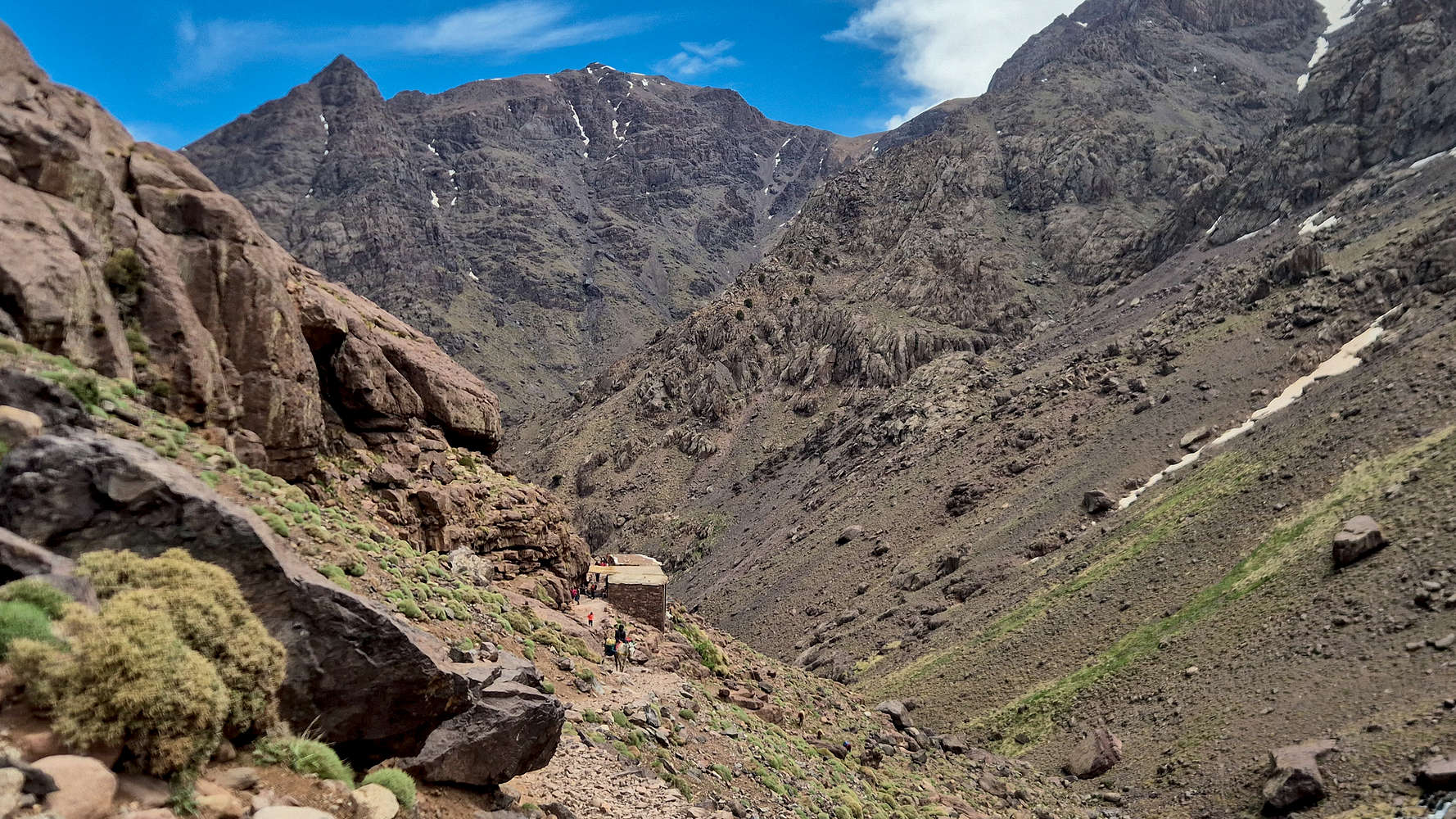
Tarharate (3,491m) (left) as we hike past the stalls after the pass.
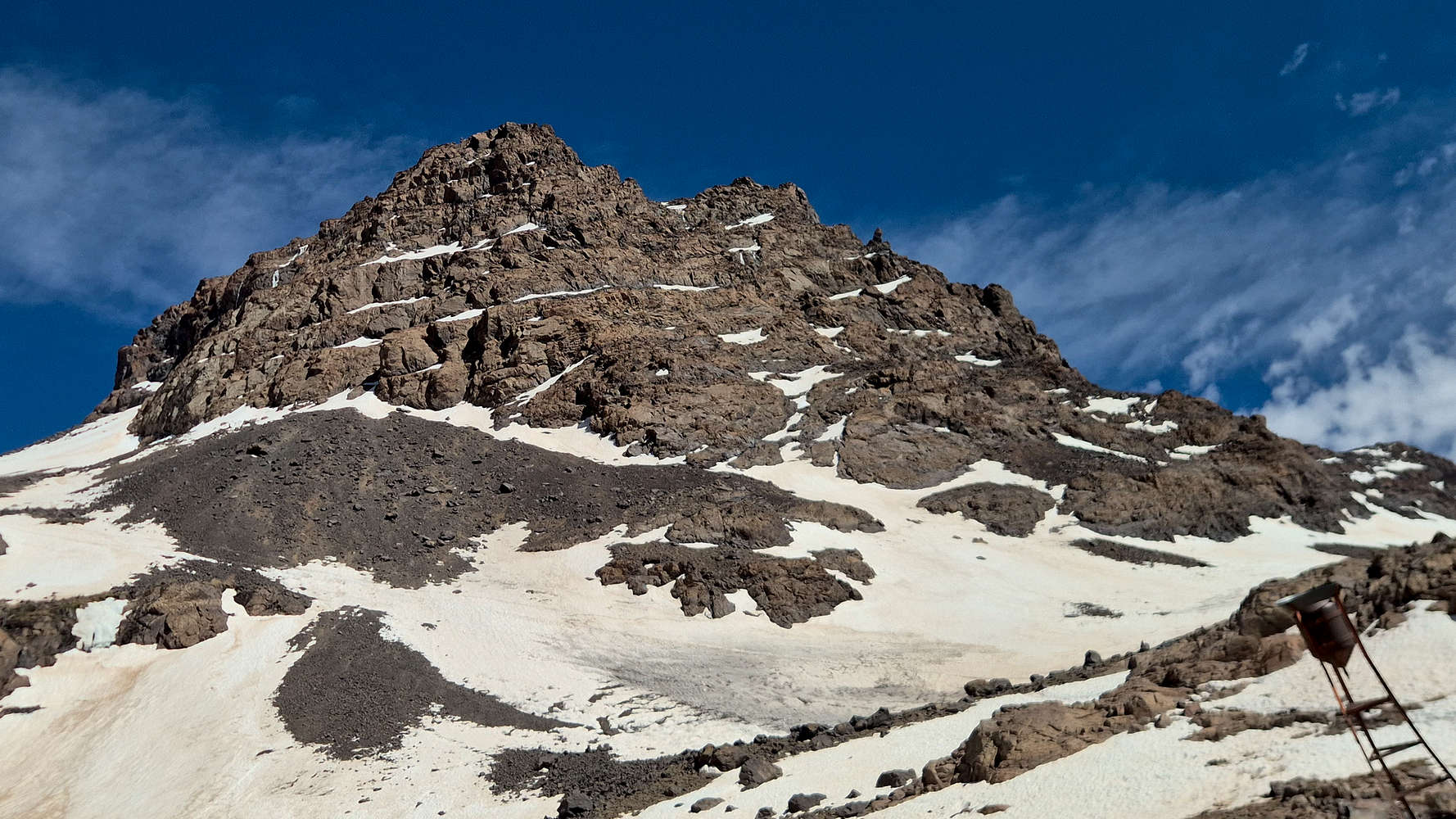
The central Buttress of Toubkal West (4,018m).
The Moroccan High Atlas is the most important mountain range in North Africa, and has an extensive history reaching all the way back into geological time. Yet most important has been the role of these mountains as a physical boundary between North Africa and Sub-Sahara, something which enabled the rapid rise of the Almoravids during the 11th century. Specifically, the passes controlled the trade of slaves and gold into Morocco, making those controlling them exceptionally wealthy in the process. This is also a source of some ethnic distinction since the Amazigh tribes of the Atlas were later overshadowed by Arabs who installed themselves in northern Morocco. Today the Amazigh peoples remain steadfast traditionalists and promoters of their own distinct language and culture. For the Amazigh, poetry continues to represent a socially important and well-regarded art form. With its roots in tribal traditions and needs still intact, Tamazight poetry offers a unique timelessness, being performed in a nearly unchanged manner for thousands of years. The most common poem, the Izil, shares its form with Byzantine poetry, formed by two hemistiches and using a fifteen-syllable measure[1].
Taougrat Oult Aissa, the female imedyazen (poet) of the Sokhman tribe was one of the earliest voices of the anti-colonial struggle in Morocco.
For being so near Europe, the Atlas had remained unexplored by Europeans until very recently, in fact the first ascent of a westerner to Jbel Toubkal (4,176m) came in 1923 by the Marquis de Segonzac, V. Berger and H. Dolbeau; that is 12 years after Amundsen reached the South Pole![2]
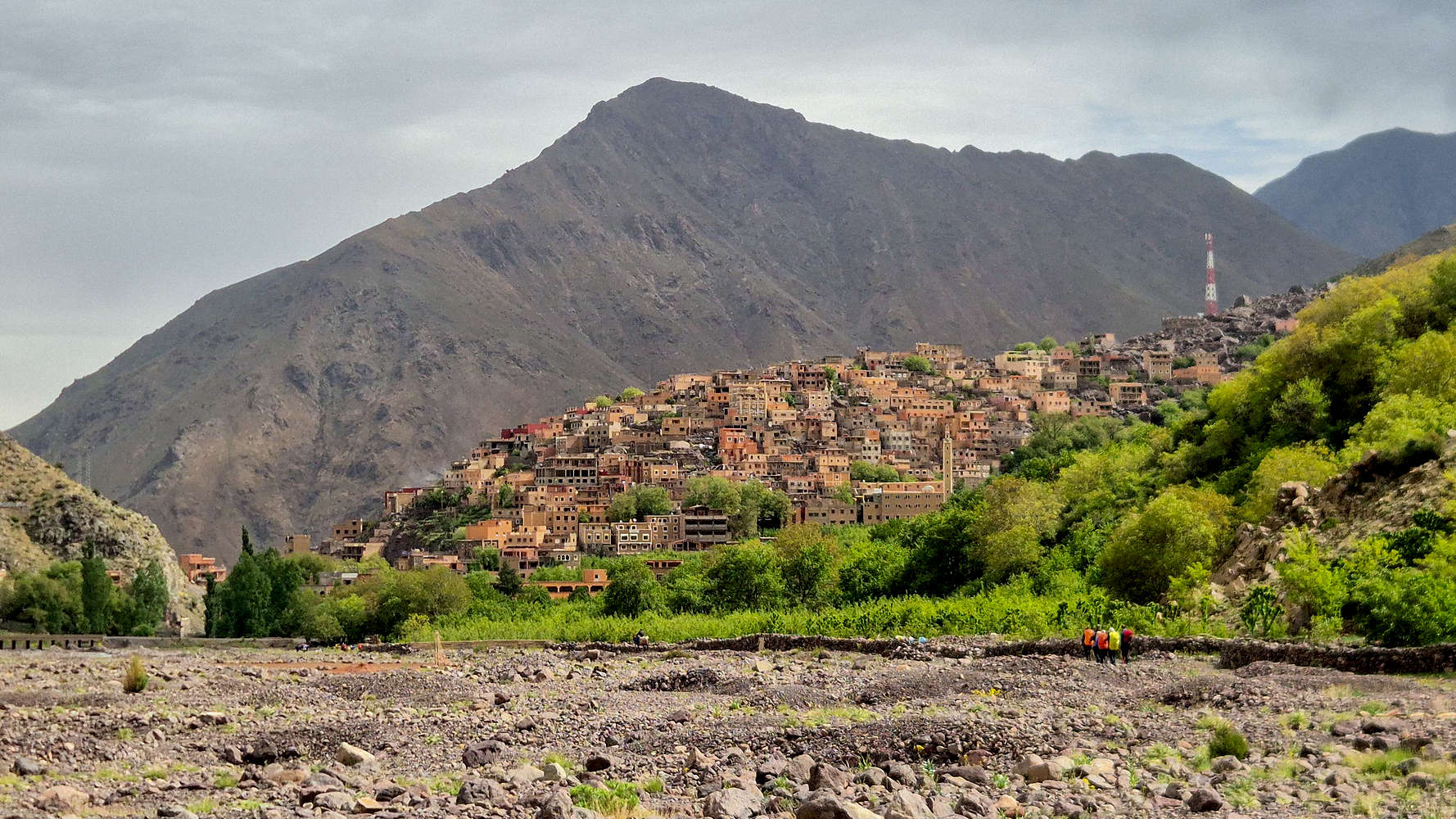
Aroumd and Aourirt n' Ouassif (2,726m) behind.

The minaret of the Kutubiyya mosque in Marrakesh.
Our itinerary would bring us from the bustling city of Marrakesh to the Berber outpost of Imlil (ⵉⵎⵍⵉⵍ), then a few hours of hiking would put us at the CAF Refuge at 3,200m from where we could attempt the summit of Jbel Toubkal (4,167m) before returning to Marrakesh that same day. After some rest, we would have one full day to sample the culture, food, and shopping of the city before flying back to Athens. Compared to most Toubkal expeditions, the itinerary was a day longer to accommodate sightseeing; and as is common for the High Atlas, the probability of poor weather was overlooked, and no weather window was organized.
Interactive Map
Day 0: Acclimatization on Parnassos
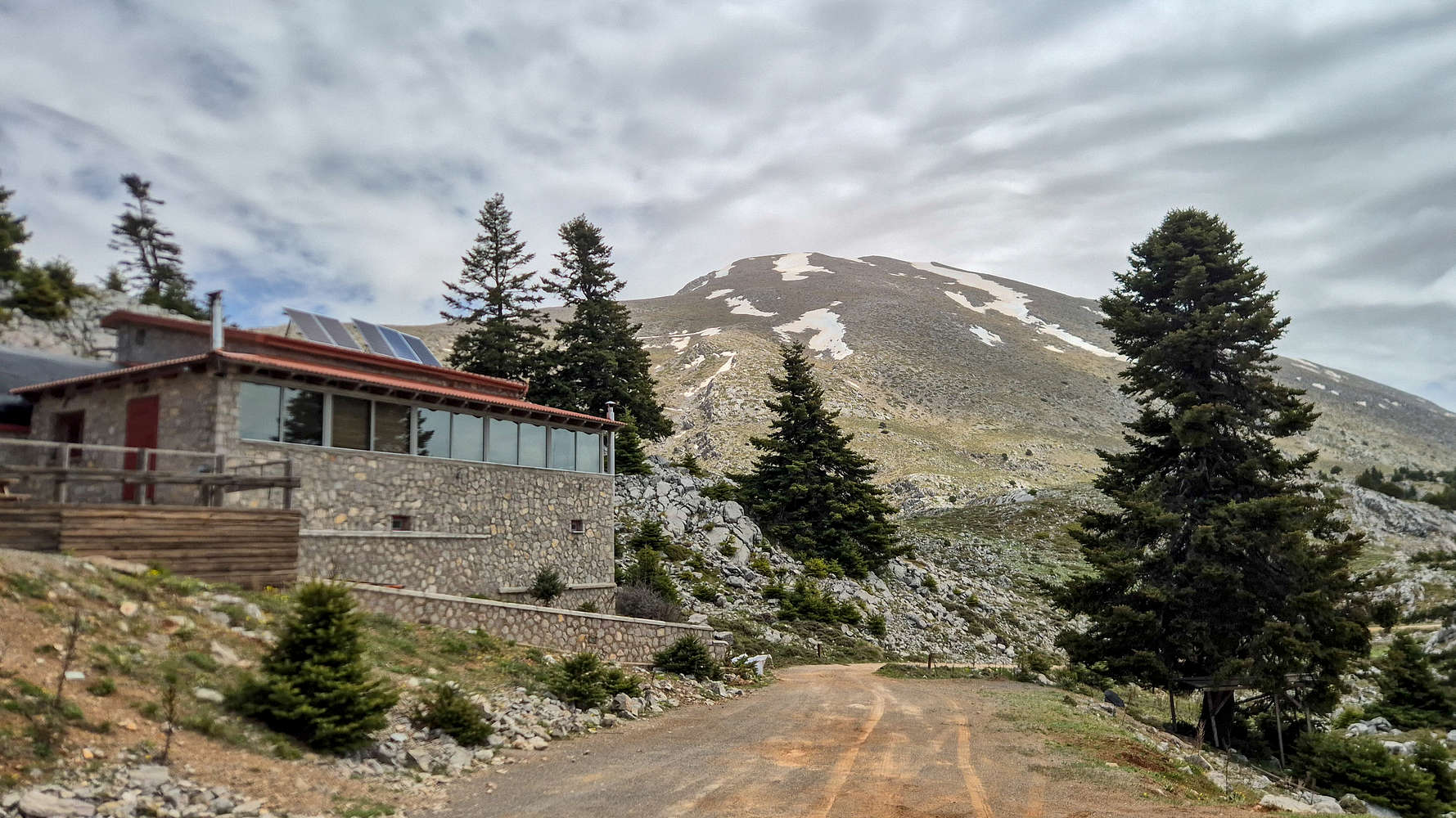
In preparation for our trip to the High Atlas, where we would attempt Jbel Toubkal (4,167m), and sleep at the CAF Refuge at 3,207m, we decided that it would be a smart idea to prepare with some acclimatization. With the elevation of Imlil at around 1,800m, we decided that offsetting the effects only partially would be good enough, and spent one night at 1,800m, on Parnassos, about 36 hours before our flight. This also gave us a chance to practice with our crampons. Read more about this trip and peak below:
Day 1: Athens to Imlil
Our early morning flight to Marrakesh with Aegean faced strong westerly winds and was delayed by nearly an hour. Upon reaching Marrakesh we were doubly confounded as Terry was unable to understand and withdraw from the ATMs. After I took it upon myself to do so, we met with our pre-arranged transfer (via Booking.com), which was also woefully late. But all in all, we were in Marrakesh, safe and sound with all our gear. Next stop Imlil.

The Atlas range from the plane during landing.
Driving to Imlil
As we slowly exited the city my apprehension in visiting a country outside Europe for the first time left me entirely, with the streets, buildings, and shops approximating a more beige recollection of life in provincial Greece. The snowcapped peaks of the High Atlas could be seen rising far above the horizon in menacing shades of black as we drove through the arid plains that lead their foothills. Our driver soon stopped at a roadside shop, and offered us some water, crisps, and a Moroccan chocolate snack I became fond of. In less than an hour the flat landscape gave way to beautiful hills of red (mostly Clay) carved by millennia of fluvial activity. Dominated by the beautiful colors of the late spring the river valleys leading up to the mountains seemed to almost welcome us.
I found the soft melodies and aethereal notes Tuareg musicians Kel Assouf to be an excellent accompaniment to the grandeur of natural beauty which unraveled in front of us.
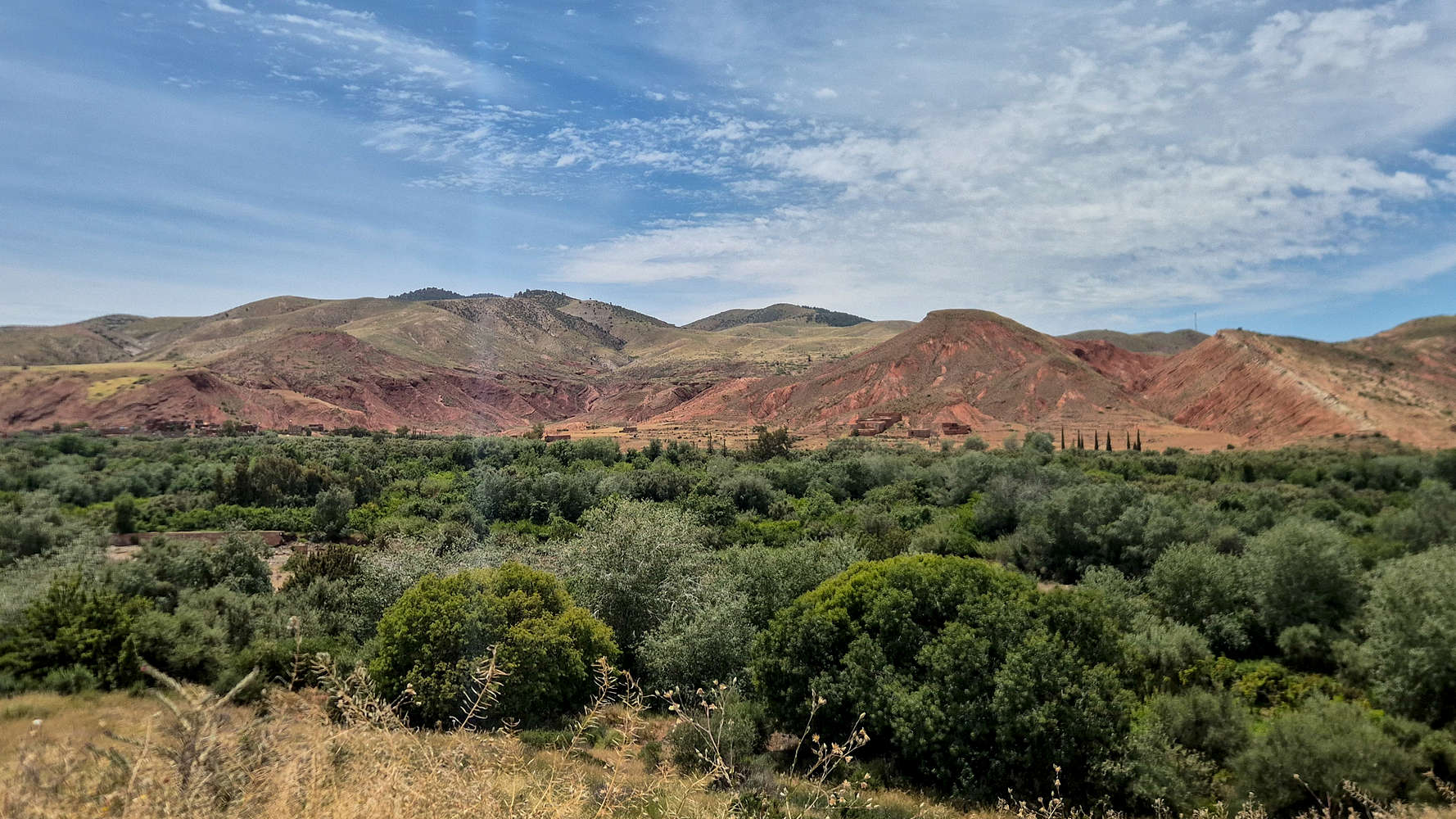
Hills of Clay near Tahannaout.
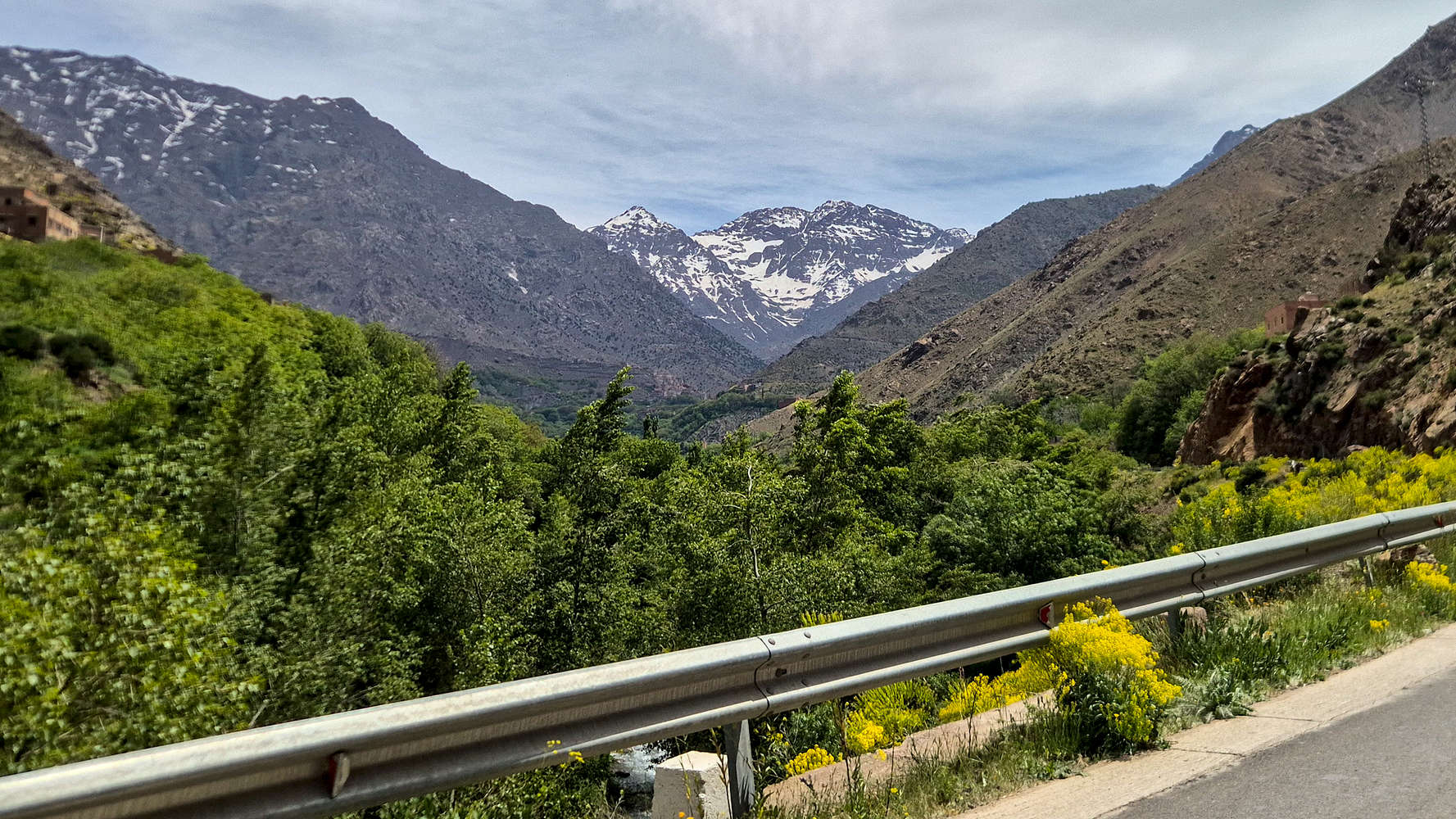
The NW aspect of Aksoual (3,912m) from Ouaoussalt.
Passing Tahannaout and then later Moulay Brahim the terrain becomes considerably more mountainous, featuring a narrow road above a steep river valley adorned with limestone outcroppings. Above Asni the valley widens again, with the riverside meadows where farmers could be seen working being overrun by Western Cattle-Egrets (Ardea ibis) looking for their lunch. It was not long after that we ascended the narrower valley of Oued Rheraya and made our way towards Imlil; the nearly 2 hour drive had passed us by a little too quickly. We crashed back into reality by checking into our accommodation Riad Berber Towers, and meeting our guide, Faical Bourkiba.
Weather Conditions
The weeks leading up to our expedition, we had been cautiously monitoring the weather, and it had remained unrelenting. The forecast for Thursday (summit day), continued to show strong Western winds and dire storm conditions. Having been delayed on our flight and drive into Imlil there was no option but to continue with our plan, and hope that Thursday would unexpectedly bring us good weather.
How could you reach me in the mountains?
The cedars are cut, O melancholy of love!
Did you arrive on the wing or were you carried by the west wind?
Maybe there was a thing or two I could have learnt from the above traditional Tamazight poem.
Hiking to Imlil Waterfalls
After settling into the cozy riad, enjoying our first taste of Moroccan mint tea and getting to acquaint ourselves with Faical, we decided to hike to the popular Imlil waterfalls before dinner. Starting from the village, we meandered through its streets before making our way uphill towards Aroumd. As we walked hordes of hikers were coming down from the mountain. The trail although short can be very busy since day-visitors, trekkers, locals, and workers all use it to go between Imlil and Aroumd. Once the lower section is completed, a small off-shoot trail with water-channels takes one towards the waterfalls, in the final meters a new metal bridge is crossed to reach their base. On account of the season’s snowfall totals, the falls were overflowing on our visit and we were lucky enough to be able to enjoy a cup of tea in peace before day-visitors arrived.
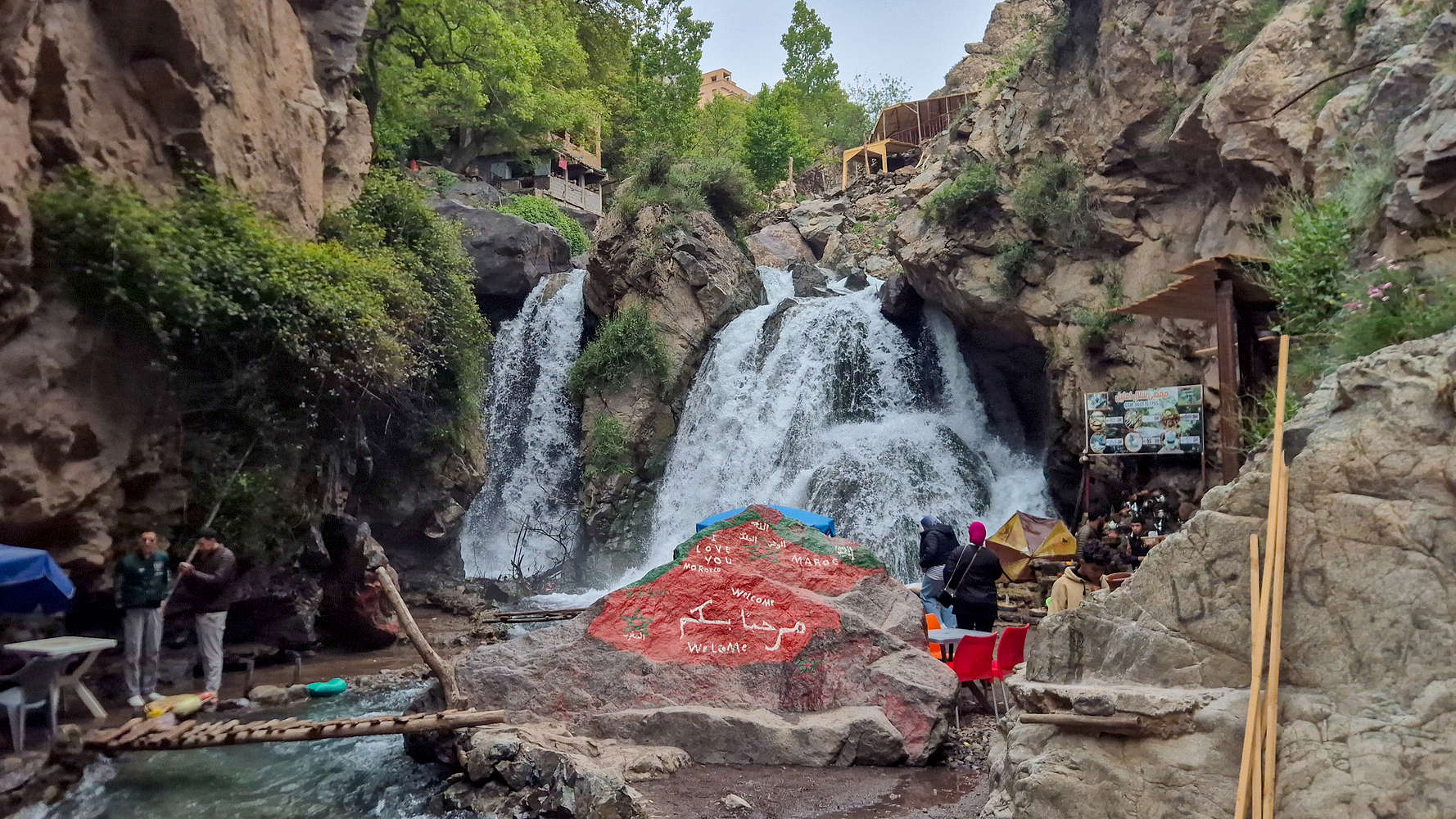
Quiet Imlil waterfalls.
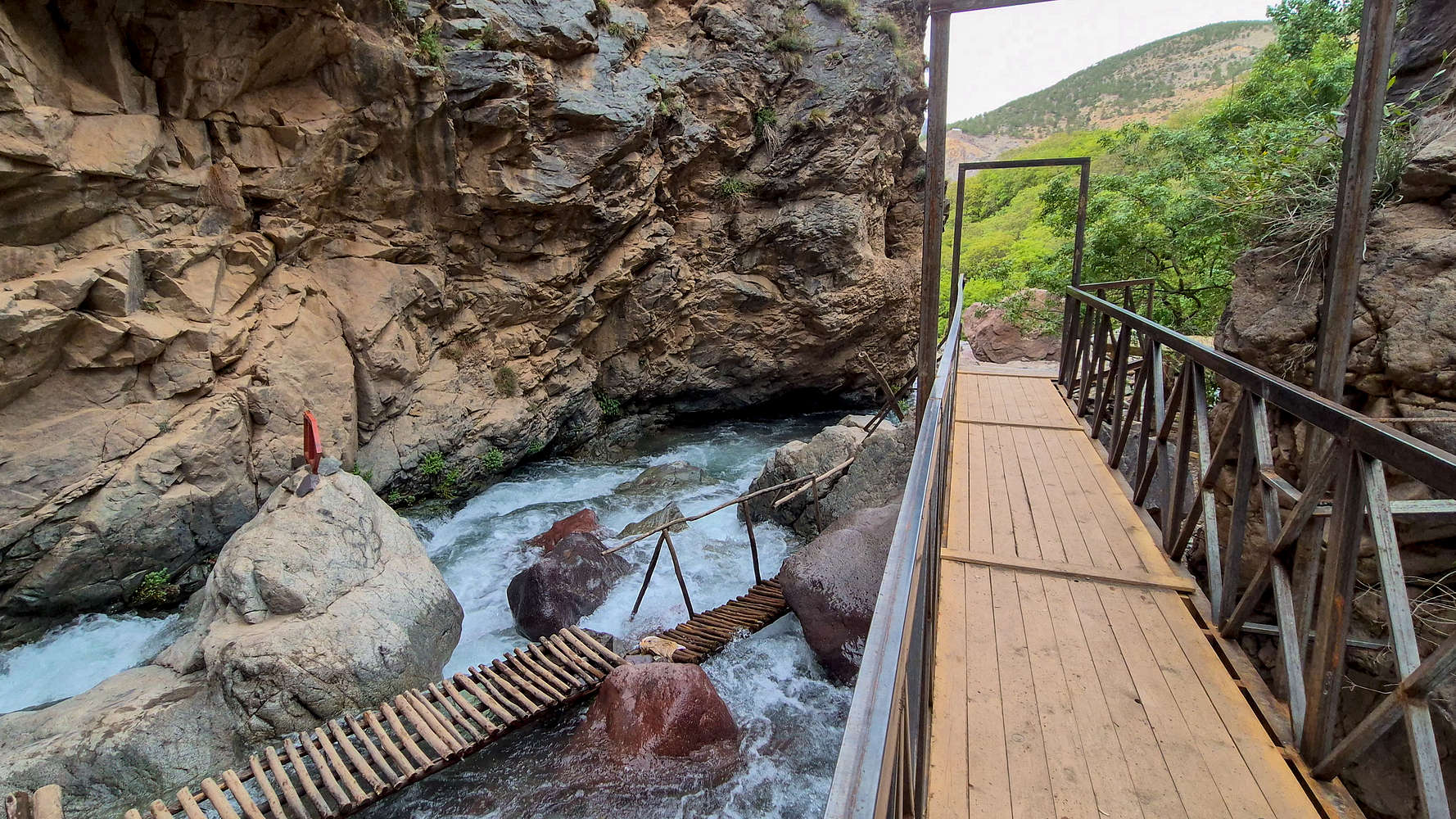
The new (right) and old (below) bridge for Imlil waterfalls.
We spent the time talking with Faical. Although from across the Mediterranean, our independent involvement with mountains had resulted in us being very much alike. It was nice to meet and work with someone who felt the same reverence for these craggy giants as us. I was glad to be informed, in his openhearted way — to which we became accustom to — that the admiration went both ways. The return hike went by much smoother, and in total our very relaxed outing lasted no more than 2 hours.
Dinner at the Riad
We returned to the riad rather early, aiming to pack and eat, since the following night would be spent at altitude. After sorting our bags, we enjoyed a lovely homemade Tagine with a pleasant accompaniment of red peppers and mint tea. Terry’s request for some rice was responded to quizzically, I couldn’t help but laugh. Faical was invited to dinner by Omar, the owner and former guide for CAF, while we ate with the company of a lovely couple of Canadians, who seemed a little too overwhelmed by Marrakesh. For us the visit to the city still felt a little distant.
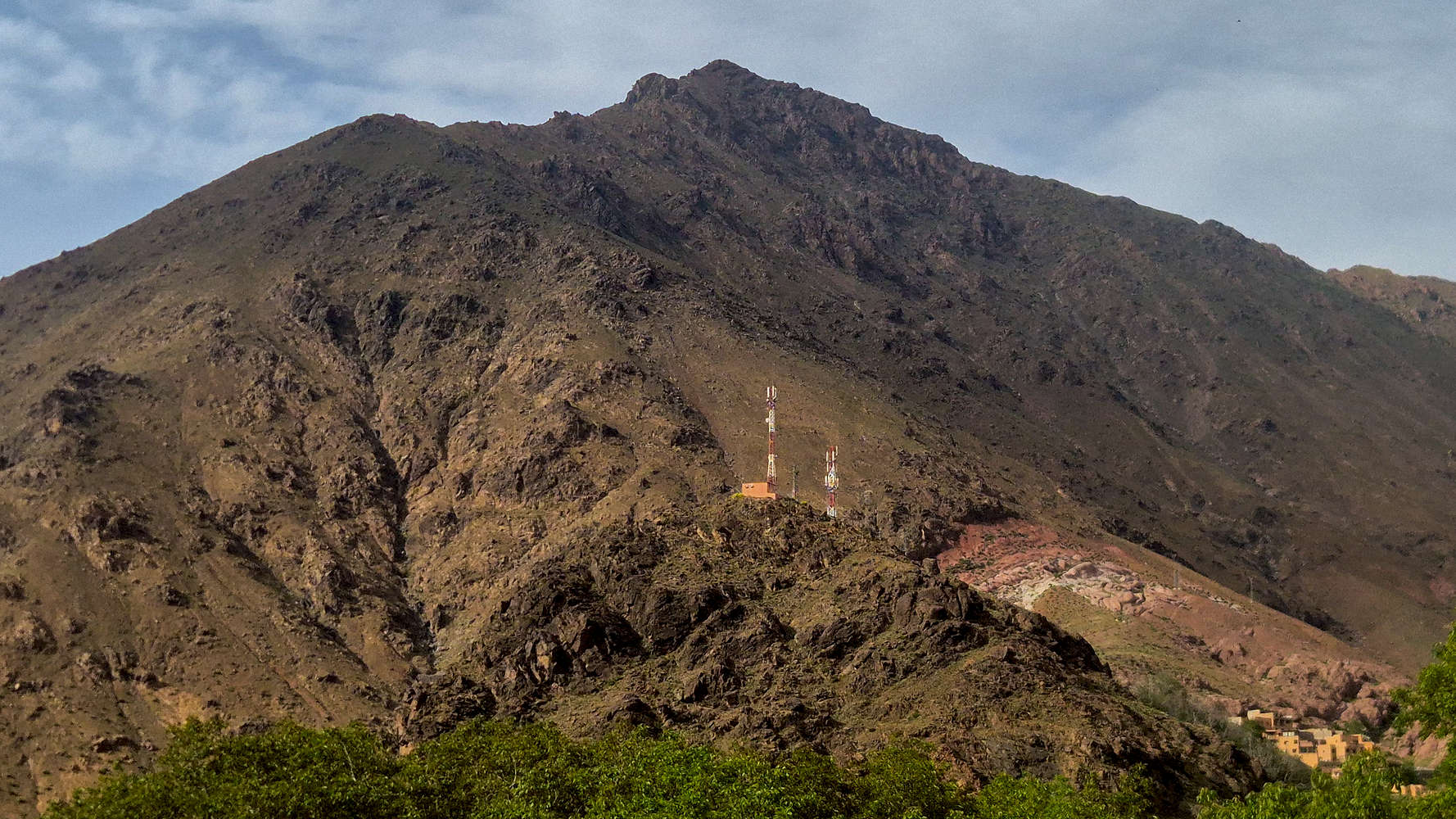
Aourirt n' Ouassif (2,726m) as seen from near Imlil waterfalls.

A Starling flying past the NW Face of Aksoual (3,912m).
I spent about an hour hanging out outside the riad, smoking cigarettes and birdwatching. I managed to spot a Common Bulbul (Pycnonotus barbatus), a Spotless Starling (Sturnus unicolor), and an African Chaffinch (Fringilla spodiogenys) before withdrawing to bed under the soft light of dusk.
Day 2: Hiking to CAF Toubkal
It must have been that our acclimatization night on Parnassos paid dividends since we both slept long and well, certainly enough to fuel the next 36 hours of physical exertion. At breakfast the energy was undeniably electric, and pending our own pace on the approach we maintained a hope of reaching the summit on the same day, in an attempt to avoid the poor weather on the next. Having done our best to eat the lovely breakfast spread, Omar agreed to drive us to the trailhead past Aroumd, saving us about an hour worth of hiking.
It was only right that the short drive featured, among others, the most electric of Anti-Atlas Amazigh tunes by one of the most modern of local bands; attached for your listening pleasure:
The Route
We arrived at the trailhead past Aroumd around 09:00, early enough to consider a continuous summit push. We walked off among the Apple trees and clay walls of the last houses of Azib Assougolor and in near silence crossed Oued Rheraya for the first time; we were now on the High Atlas. The morning was quiet although slowly the commotion of mules and porters leading ahead of the larger groups would catch up to us. This was not on our mind yet as we navigated through the floodplain, and began to tackle the first set of switchbacks. Soon the air buzzed with familiar sounds: the running water, the tweeting of birds and, the “Salam Alekums” we offered freely to locals and porters. It took us around 40 minutes to gain the +200m of elevation gain over 2km to the lower police checkpoint on a very good trail (T1+).
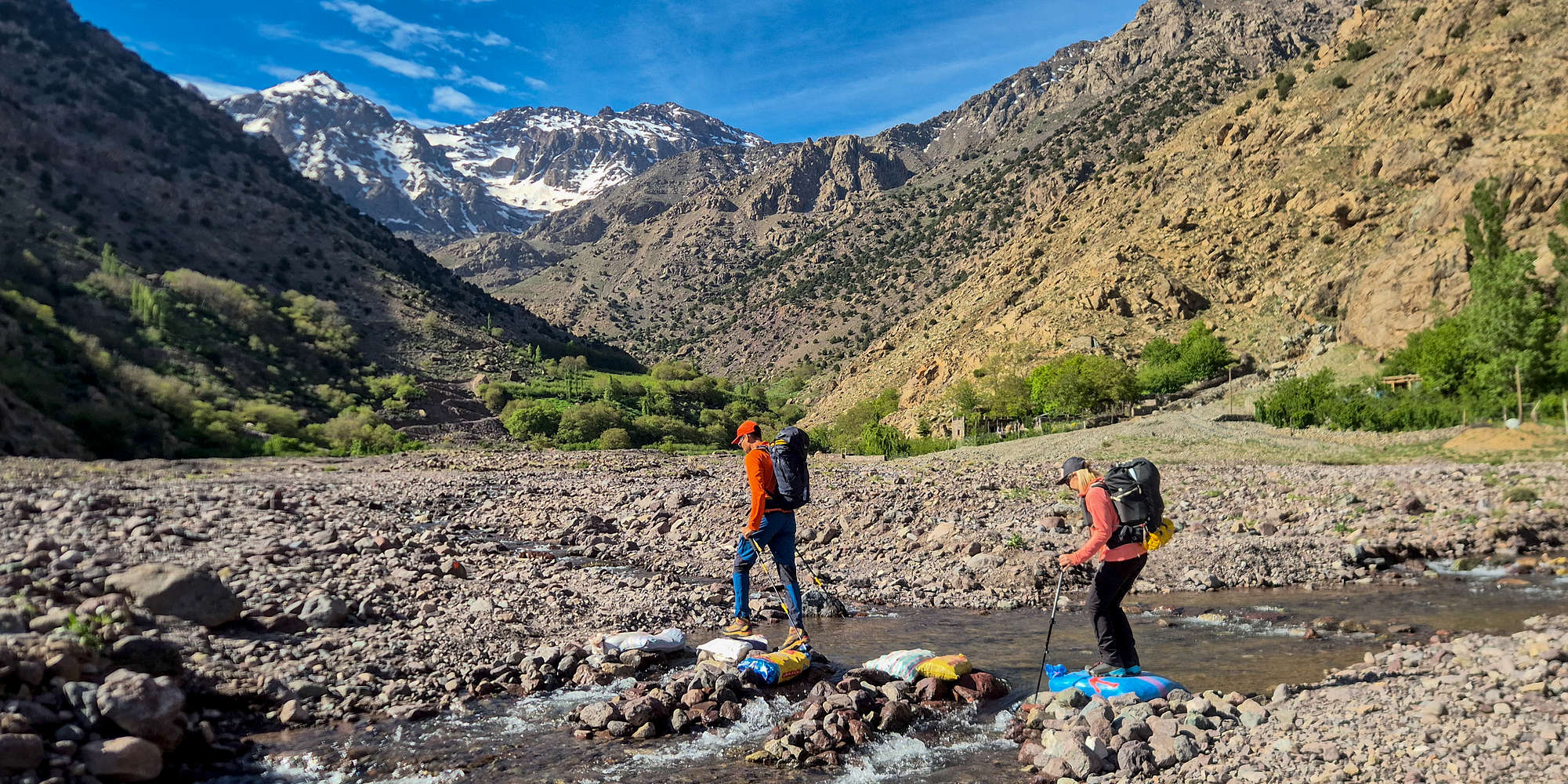
Crossing the Oued Rheraya into the High Atlas.
Thus, the first break was mandatory, as Faical took our passports upstairs to be recorded. Already suffering from the heat, at 2,000m no less, we took the time to rehydrate and de-layer. Before heading off, a curious Moussier's Redstart (Phoenicurus moussieri) sat by my feet; the most famous of the Atlas endemic species and smallest of its genus[3]. Our route continued pleasantly, with the trail offering expansive views into the narrowing valley with massive boulders scattered on either side. The first of countless mules overtook us, with Faical explaining to us that we must stay on the hill-side as they do so to avoid being kicked off-trail. Soon we reached the first of many stalls selling waters, sodas, snacks, and orange juice on the approach; a truly alien sight.
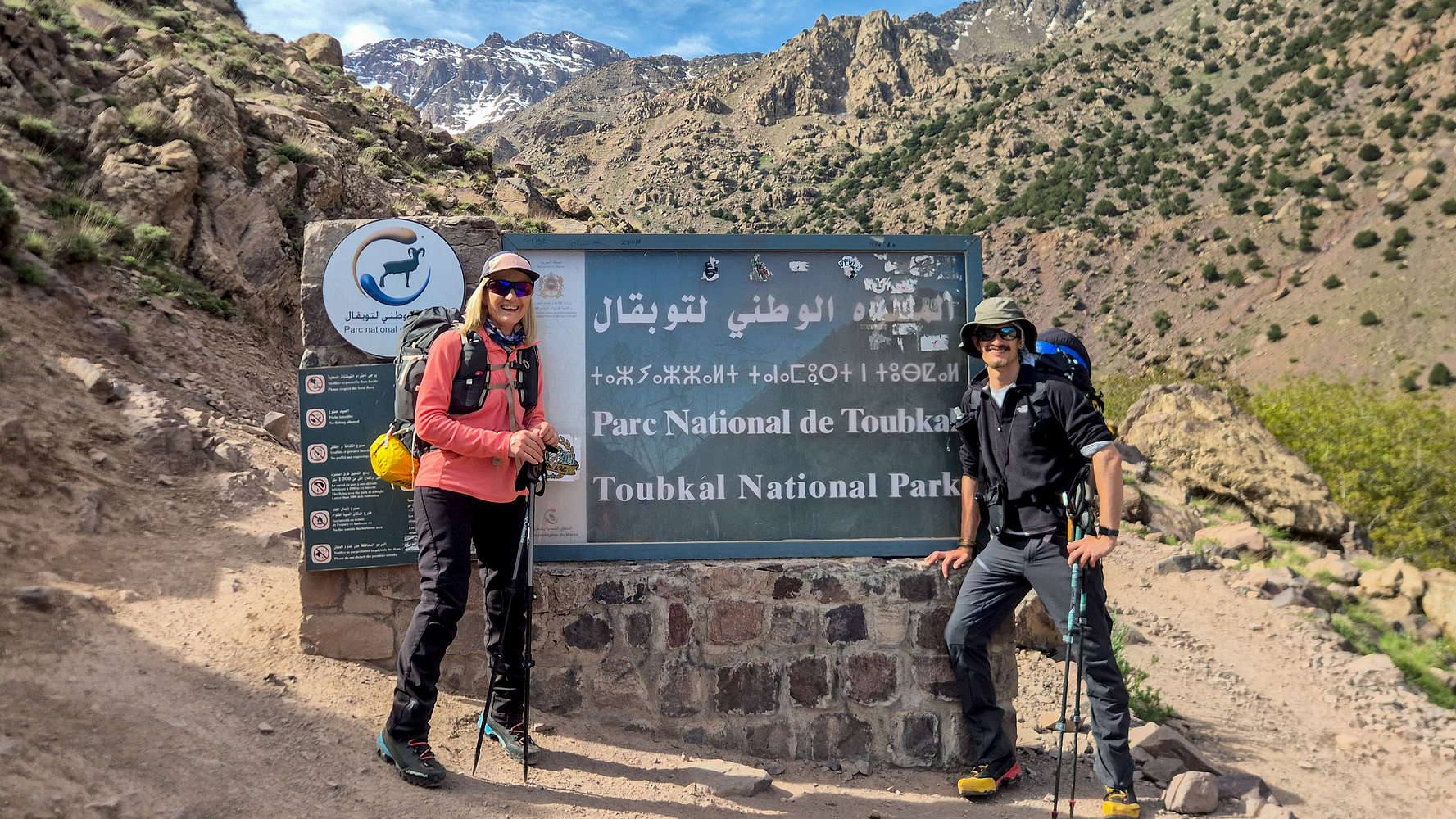
Happy to be entering the National Park.
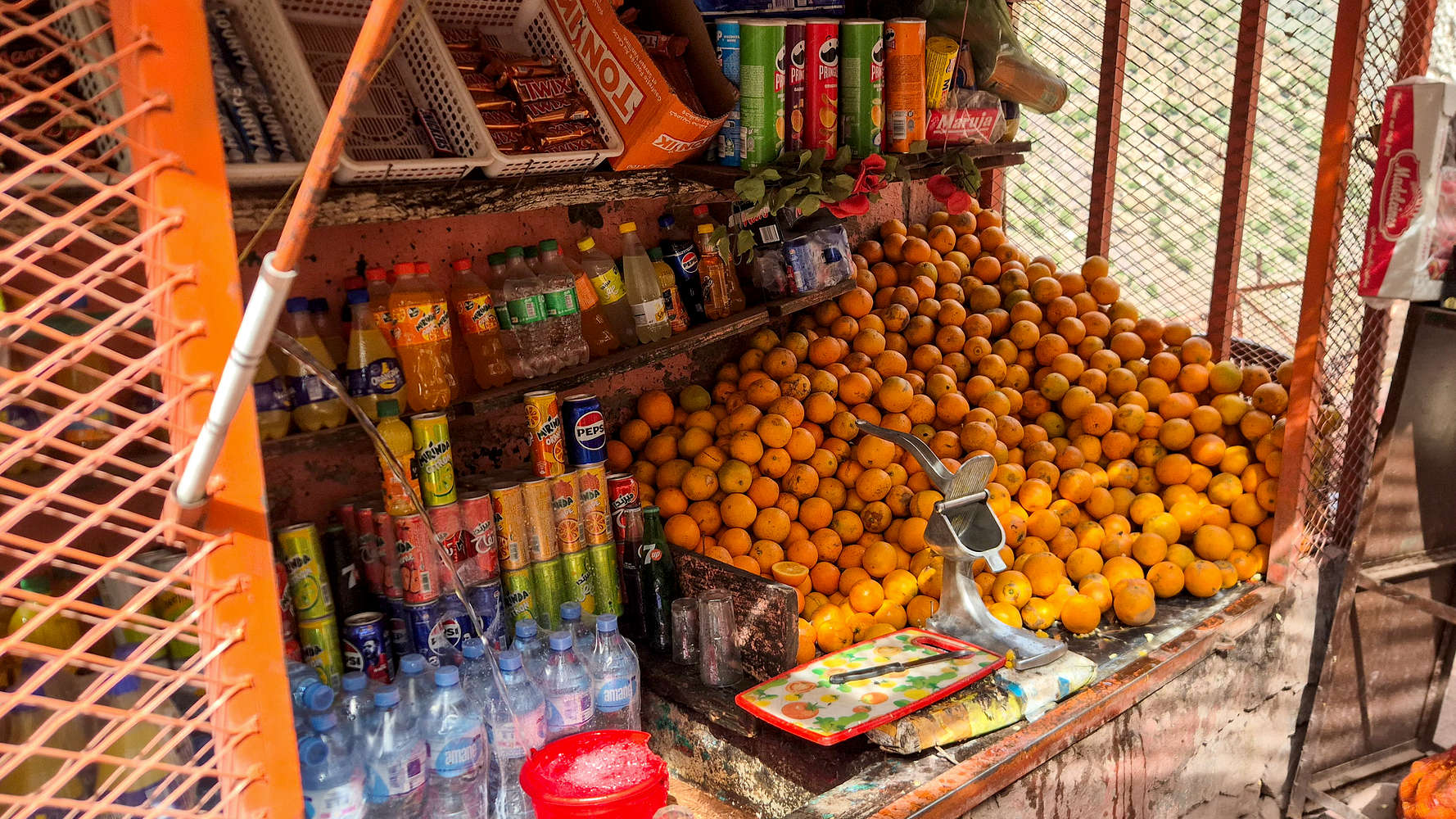
An ‘orange juice’ stall on the lower approach.
The snowcapped peaks looming above seemed closer than ever as we approached the shrine of Sidi Chamharouch, one of the famous seven kings of the Djin who rule over the days of the week, — in his case, Thursday — and into whose sanctuary no non-Muslim is allowed to enter[4]. The unique atmosphere leaves little to be desired with ample Yellow-Billed Choughs (Pyrrhocorax graculus) flying overhead, and the shopkeepers busy preparing for the noon rush. After about 1:30 hours on the so far excellent trail (T1+), we sat down at Cafe Boshib Brahim (2,300m) and we all enjoyed refreshing glasses of orange juice right by the river. We rested for a good 20 minutes before continuing onto perhaps the toughest section of the route.
Sidi Chamharouch being a Djin is part of the occult practices associated with the Muslim faith and is not an officially revered entity. Sidi is however one of the most famous Djins’ and believers from across the Muslim world visit the shrine during his festival each year.
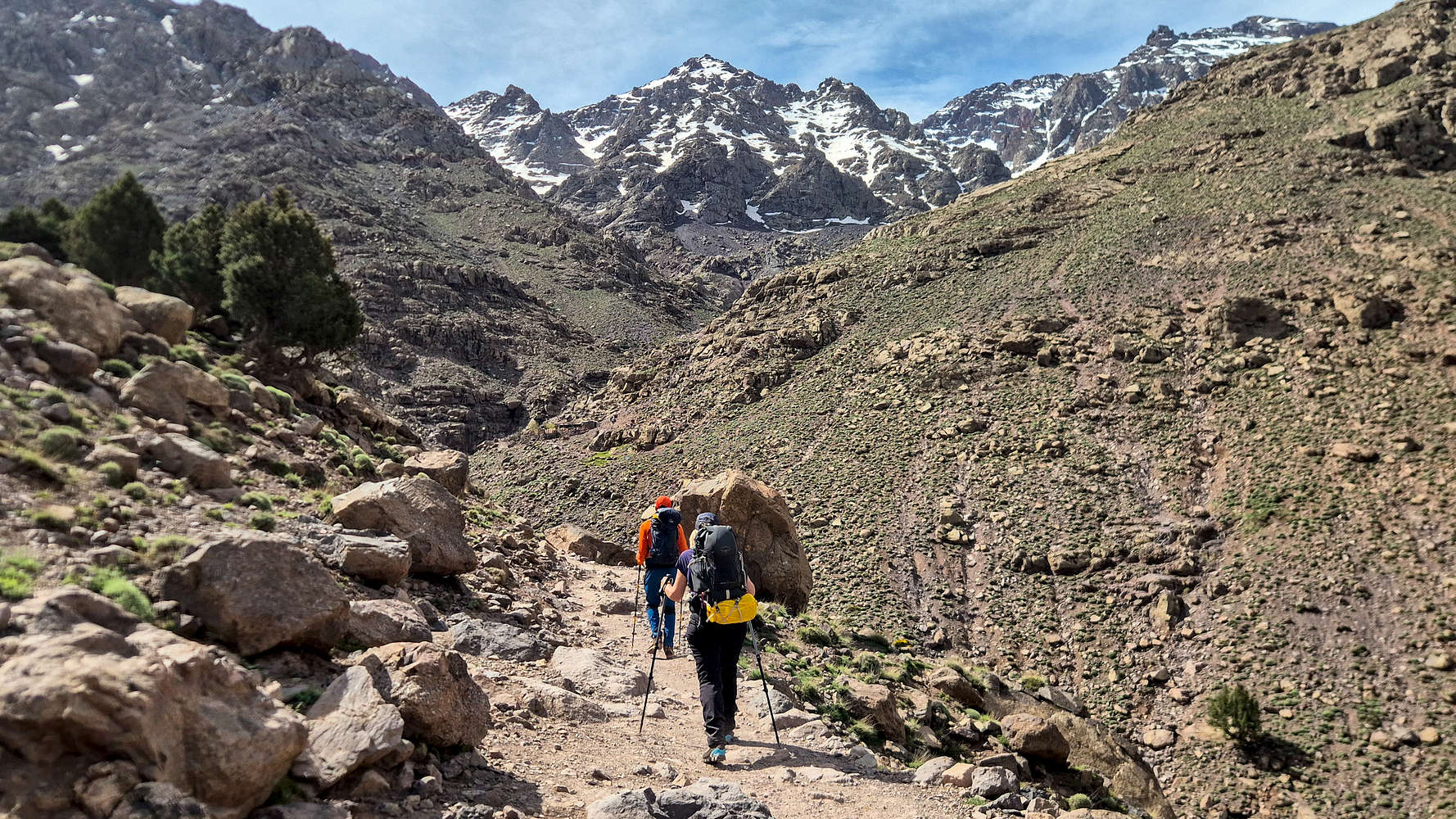
Approaching Sidi Chamharouch under the sun.
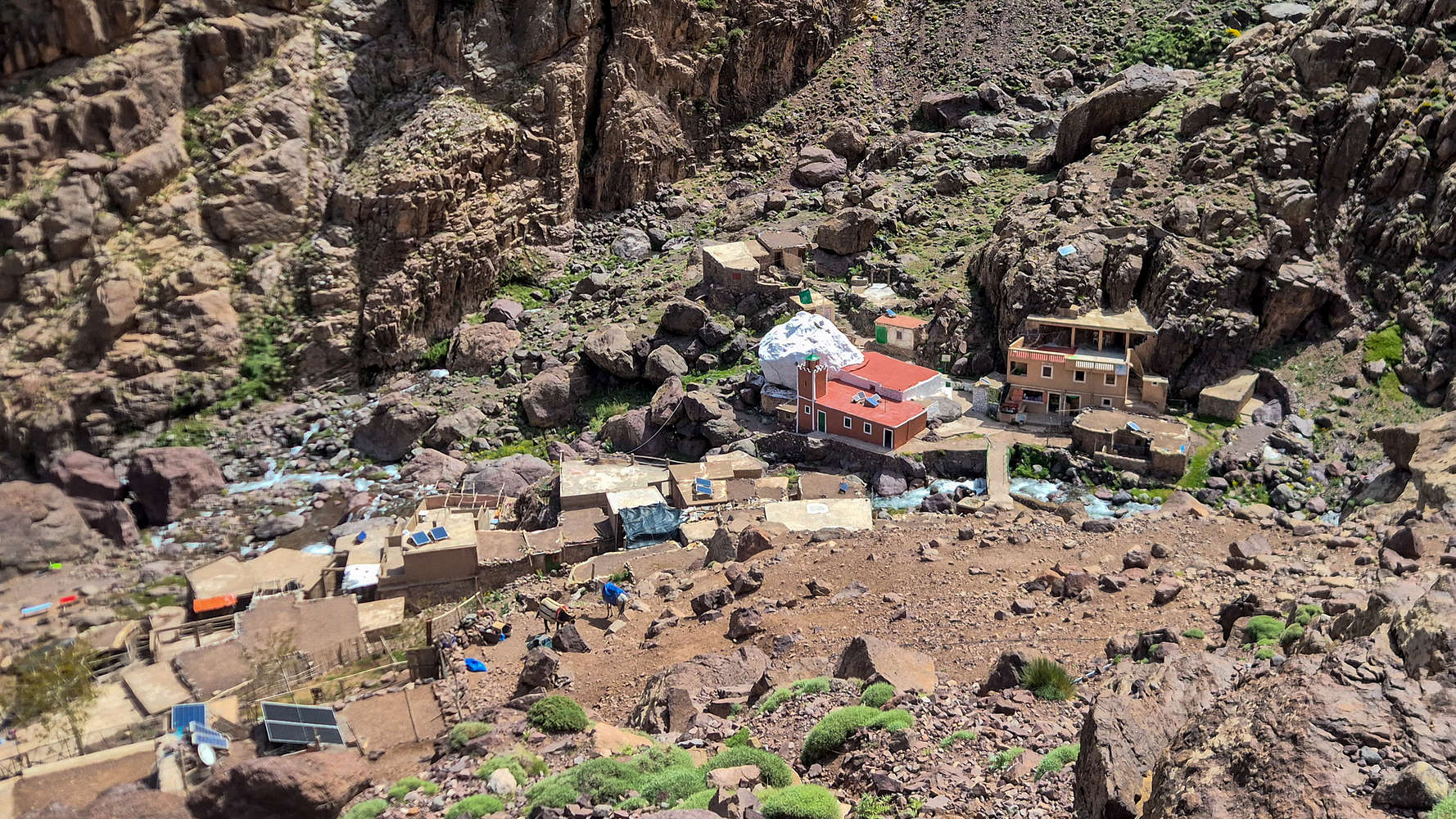
Sidi Chamharouch as seen from above.
With the clock almost at midday, conditions turned towards punishing as we ascended the pass. From here the trail quality deteriorates to T2, with certain difficulties in sharing the route with so many mules and other hikers; yet it is at no point dangerous. The ascent is immediate, with 100m of elevation dispatched via short switchbacks, while the section thereafter affords some rest, since 50m of gain are had via a direct line. This is short lived since the trail must ascent an area of scree, which it does by using two very long traverses; gaining roughly 150m of elevation, and doing so rather slowly (T2). The ambiance though is improved by a combination of impressive mafic formations and a much airier view, both ahead to the snowy Isougouane valley, and to the high peaks surrounding us. Exiting the traverses, another 100m is had via a direct line, now along the valley, bringing one to a set of quaint shops nestled next to an overhung outcrop. In the 1 hour it took us to hike this section we had gained 350m, and were on the long home stretch to the refuge.
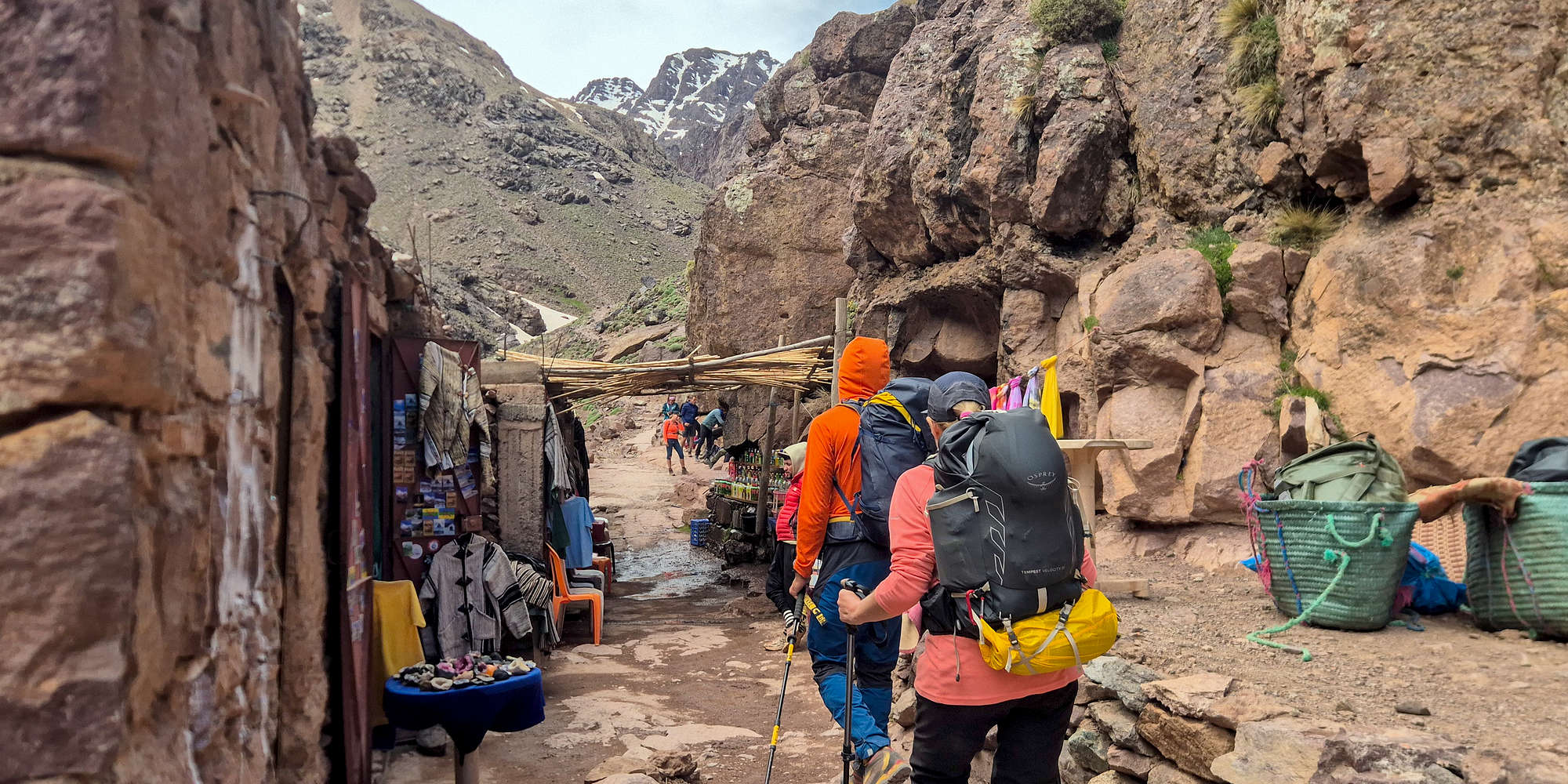
A busy rest stop right after the Sidi pass.
Given our pace Faical suggested that the next stall would be a better stop, and we agreed, seeing that we had just gotten into a good rhythm, albeit 3 hours in. This section offers wonderous views of the North face of Imouzzer (3,966m) and its great buttress, with large waterfalls and spectacular rock formations adorning its lower slopes. The technical difficulty and incline are both decreased (T1+), and some pace can be easily regained. Approaching the last shop I caught a fleeing glimpse of white shapes gracefully flying across the black of the rocks. It was the mesmerizing flight pattern of three Atlas Wheatears (Oenanthe seebohmi); which are perhaps the most beautiful of the high altitude birds of the range. We reached the final stall at 2,780m after 3:15 hours, including breaks.
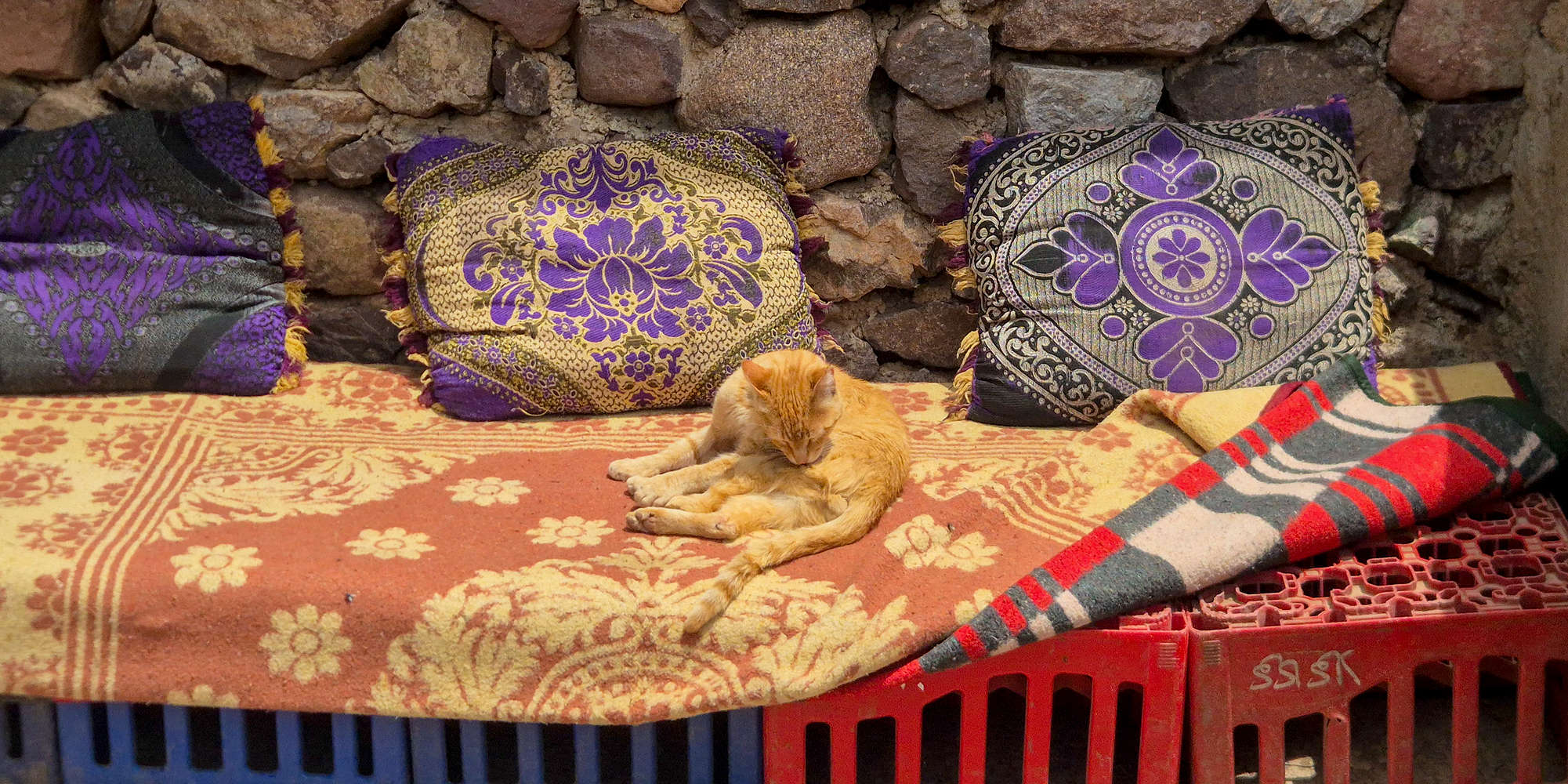
Our feline friend enjoys the sun at 2,870m.
Once again we had beat the crowds and were able to sit on the ‘terrace’ of the building which acted as a cafe. A beautiful orange cat made our acquaintance and seemed to join our group, following us out and sitting by, basking in the sun. My cravings for a sugary soda were fulfilled with a Pepsi, while Terry and Faical opted for more austere beverages. We refilled our water bottles, chatted about mountains and life, and ate some snacks; time seemed to pass rather slowly in this corner of the world. We spent nearly half an hour when the echoes of hikers approaching reminded us to get under way.
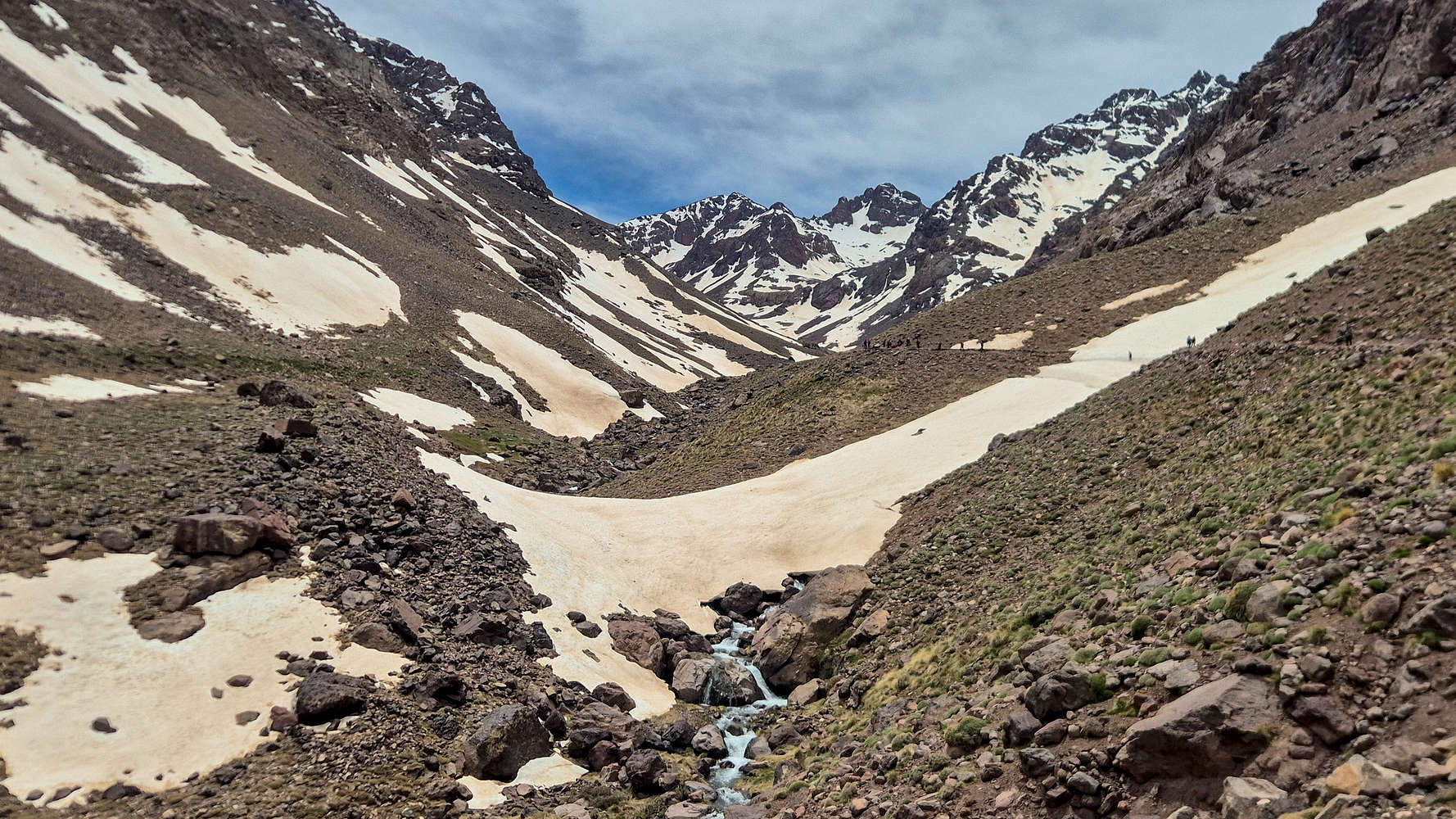
The headwaters of Oued Rheraya & Isougouane valley.
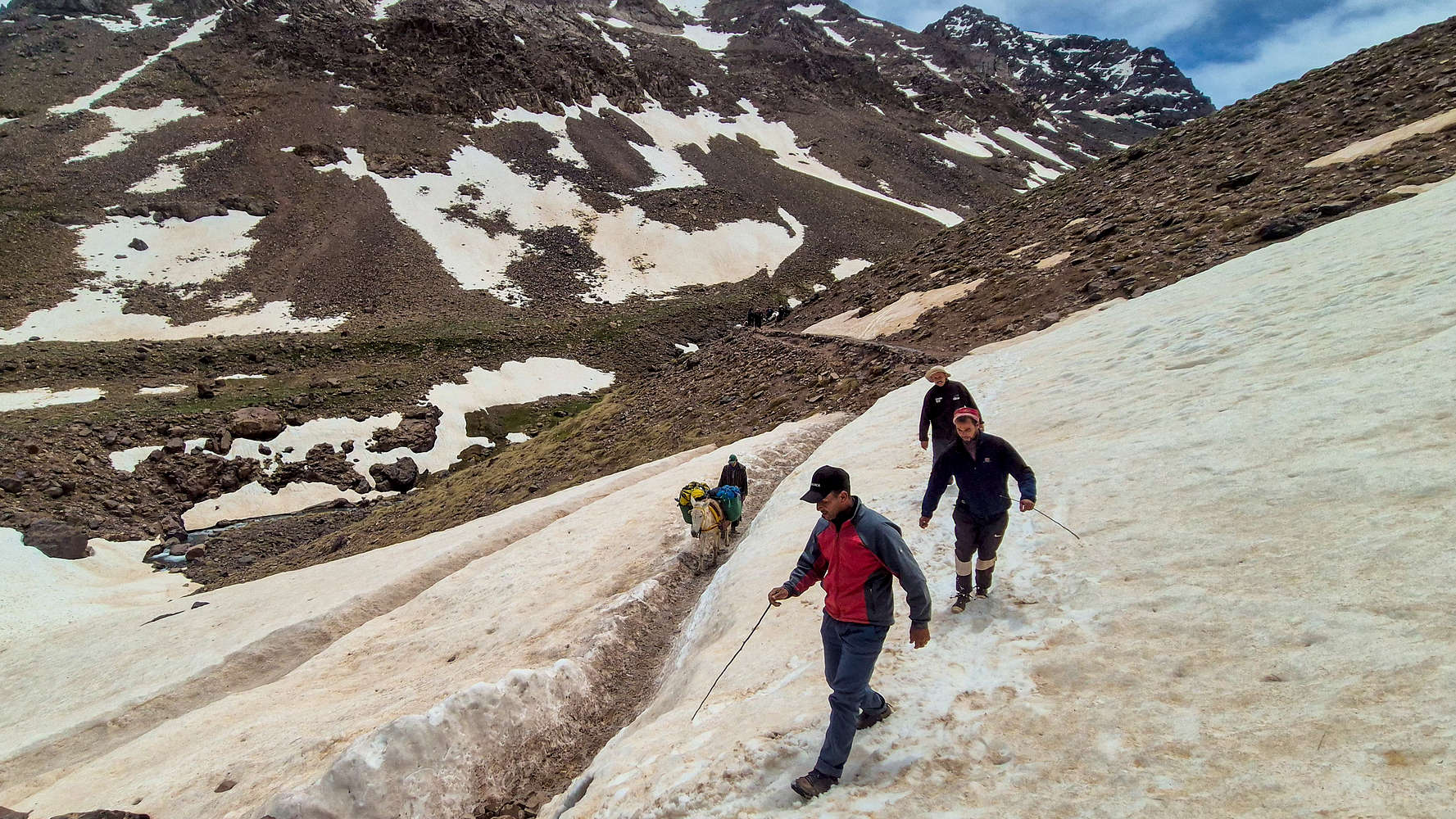
Mule and porters traversing a snow-patch.
Another 3km and 500m of gain separated us from the refuge as we embarked on the final section. Long but not particularly steep it features a lot of the same, a wide trail (T1+) with nice views, and quite a bit of traffic. In the first few minutes we crossed the primary moraine of the valley, and saw the current actual headwater of Oued Rheraya flowing through the snow-patches. Turning into the valley we were offered stunning views of the high peaks, and although quickly approaching the snow-line, we were glad to have a cleared trail. Things were not all that simple however, as a few minutes later, some porters had a runaway mule while traversing a snow-patch, scaring the life out of some trekkers; we were by now well versed in the mules.
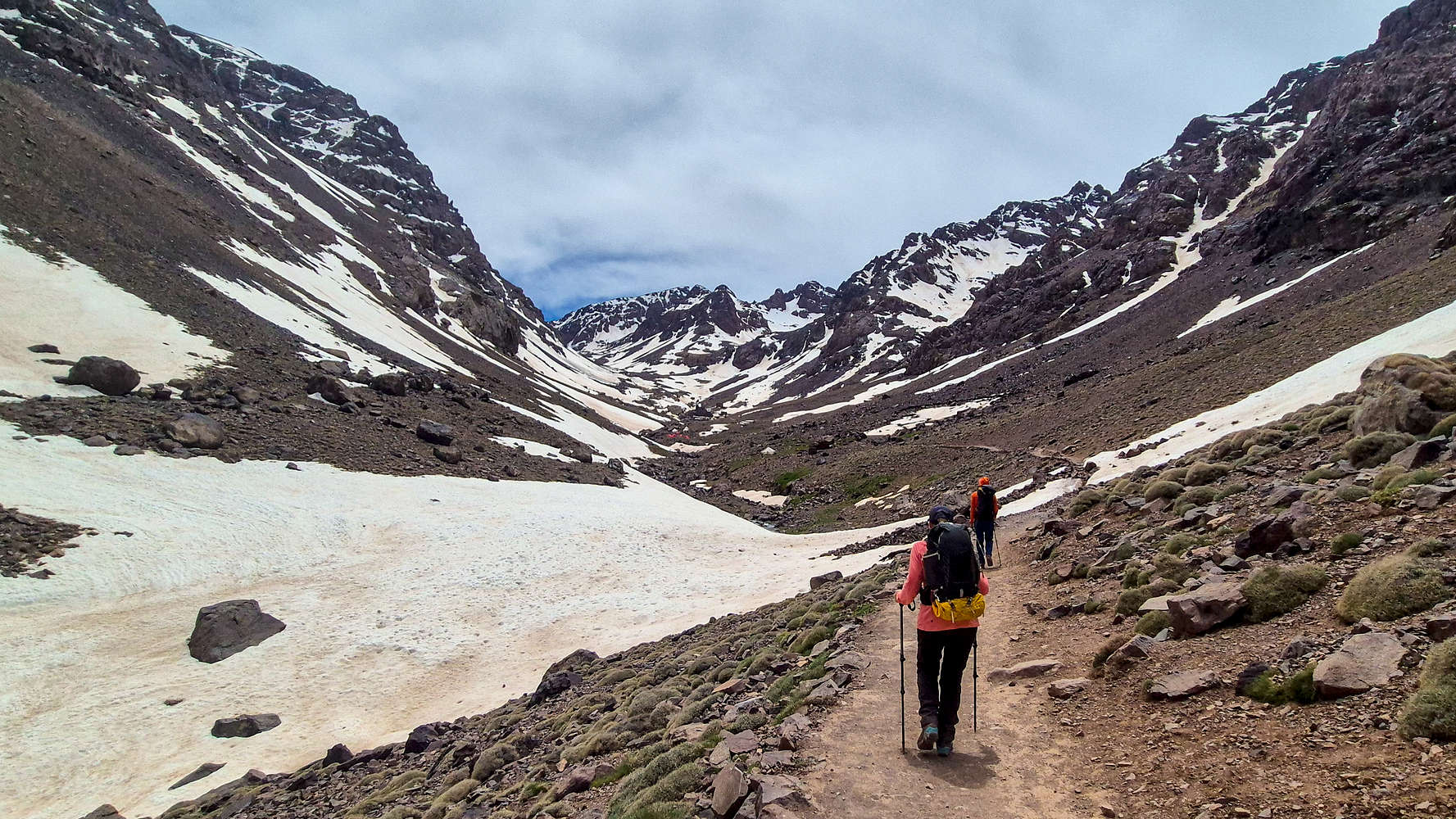
Nearing the refuge, the 4,000ers seen ahead.
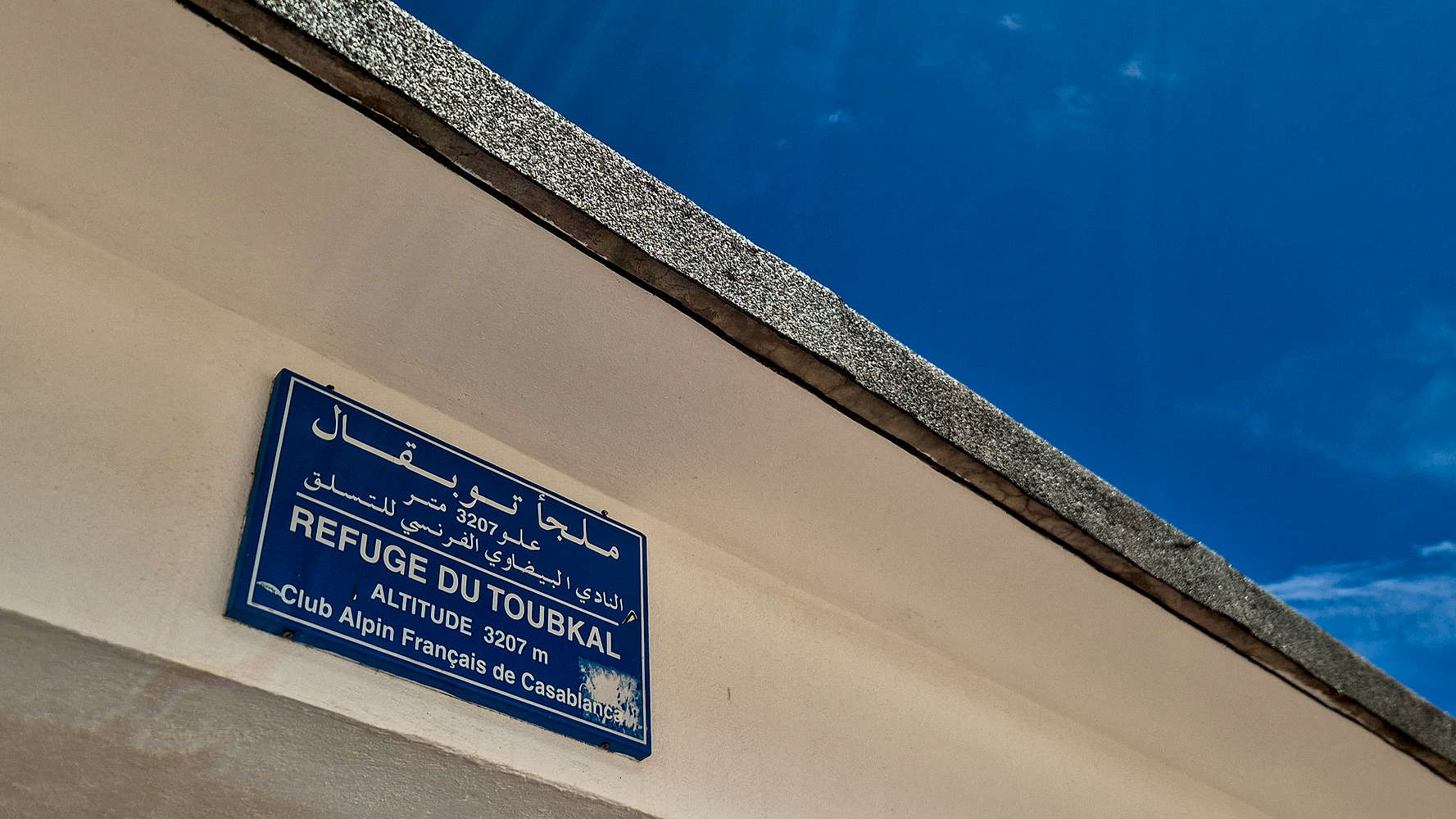
The plaque at CAF Refuge du Toubkal, 3,207m!
Far ahead I caught a glimpse of the refuge, and like a sailor at sea found myself joyfully yelling at my companions. We had just surpassed 3,000m, a little more snow and we would be eating lunch. The remaining distance might have flown by, energized as we were, and before long we were alongside the camping tents. A couple of careful snow passages on the melting snow-patches (Snow I) brought us to the refuge complex, a rather dirty place, and fitting for the hundreds of Yellow-Billed and Red-Billed (Pyrrhocorax pyrrhocorax) Choughs. We reached the refuge after 5:00 hours, with some feeling much better than others. We decided not to press on.
Refuge CAF Toubkal
Once again we had to perform an official sign in, doing so at the refuge reception and shop. After storing our gear, the food was swiftly prepared for us as ordered by Faical, but not before I snuck out for a quick smoke at 3,207m! We were presented an exceptional spread of salads, cooked lentils, omelet, fruit, bread, and tea; Moroccan hospitality at both its finest and highest. Faical and I veraciously dug into whatever was even possible to eat — with me only avoiding any fresh vegetables, while Terry remained somewhat apprehensive. Only after I finished eating the half omelet and nearly all the lentils, which I usually avoid, as well as some snacks brought with, did I even consider taking a picture of what was for me the best meal I had in Morocco.

Now this is a refuge meal!
This as we found out however is not normal for most groups who tend to eat lunch at Sidi Chamharouch, and they instead were greeted with a curious snack: mint tea paired with popcorn and Milka chocolate filled cookies. I spent the rest of the afternoon lounging outdoors, picking up random conversations. In this time I also managed to befriend the refuge cat, a stout grey fella, by offering him some beef jerky.
Chilling outside I got talking to Marwan and Sofia, the only two Middle Eastern clients on the mountain, and with them being Egyptian and having visited Greece it was rather easy to connect. I offered Sofia some of my Greek mountain tea to help with her receding cold, and besides some smokes and jokes, saw little else of them until after dinner. We organized our dinner later than others and while charging my phone, I ended up talking with Aija, who booked the ascent last minute; I asked if she had checked the weather but she had not. Later, during a visit to the bathrooms I caught a view of a glorious purple sunset, and rushing outside to take a photo I realized I had missed it entirely. Joking about that out loud, Vika, whom I thought I had seen earlier in Crocs and shorts struck up a conversation. I couldn’t help but address the obvious to which she answered that she was in fact Russian and it felt rather warm to her anyway; she had planned this trip 2 years before, aiming to summit on her birthday, which would be the next day.
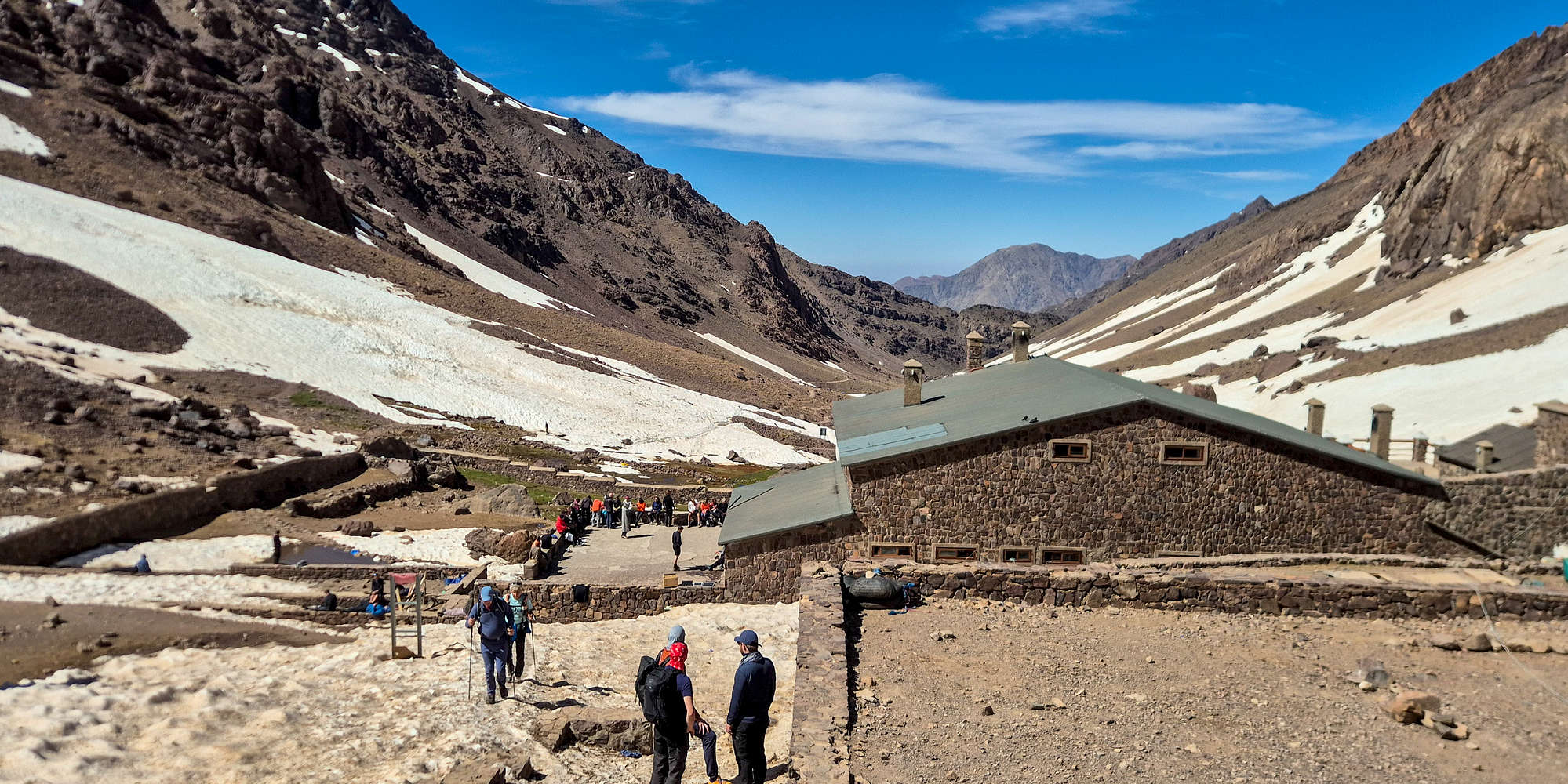
Looking down Isougouane valley from the CAF.
We were offered dinner, but the specifics are somewhat missed on me, perhaps it was omelet again, or maybe pasta. In either case, again we did our best to eat as much as possible, although already quite full from lunch. Dinner dragged on mainly due to Terry’s reluctance to eat anything. Trying thing after thing, both from our provisions, and the store, but mostly packaged, she could not find anything appetizing enough. We were however able to use the WiFi to get the latest forecast, and things looked worse than ever. Our discussion of the conditions began to spread through the guides, who accustomed to good weather were caught off guard. All the same though as the final say on summit bids can only be given by the police, and we would find out in the morning anyway.
I made my way to the overbooked dorm room late, managing to sneak in without waking anyone. The sleep mask and ear-plugs were new to me and felt uncomfortable. In the heat of the room, my brand new sleeping bag turned out too warm so I unzipped it, taking full advantage of the fact Faical was downstairs hanging out with the guides. Most people would wake up at 02:00 so these few hours of sleep were deeply cherished.
Day 3: Failure & Descent
The orchestra of banging and howling during the night had acclimated us physiologically to what may be awaiting for us in the morning. The sleep seemed adequate as the sudden noises and lights of the procession of hikers began at 02:00. I found myself half asleep still, with us expected to have our pre-departure call at 03:00. Soon enough however, Faical walked through the door and informed me that “there will be no summit”, since “the police is not allowing people to continue”, I tried to go back to sleep. Unable to do so, I went outside for a cigarette, quickly realizing the full extent of the storm. With winds well above 100kph and freezing rain, our summer equipment was woeful; I smoked in silent defeat. The polemic sounds of Terakaft hit Awa Adounia felt right at this time.
Soon, the breakfast room slowly came to life as Marwan, Sofia, Aija, Vika, and Faical all showed up for some small talk. If we couldn’t hike at least we’d get to socialize. We spent an hour or so together, stringing random topics, and stories, as well as occasionally going out for a cigarette. Each time we were faced with worsening conditions, until Marwan came back practically exasperated, “a team is getting ready to go…!”. How could this be?

Hikers leaving the dorm at 02:00.
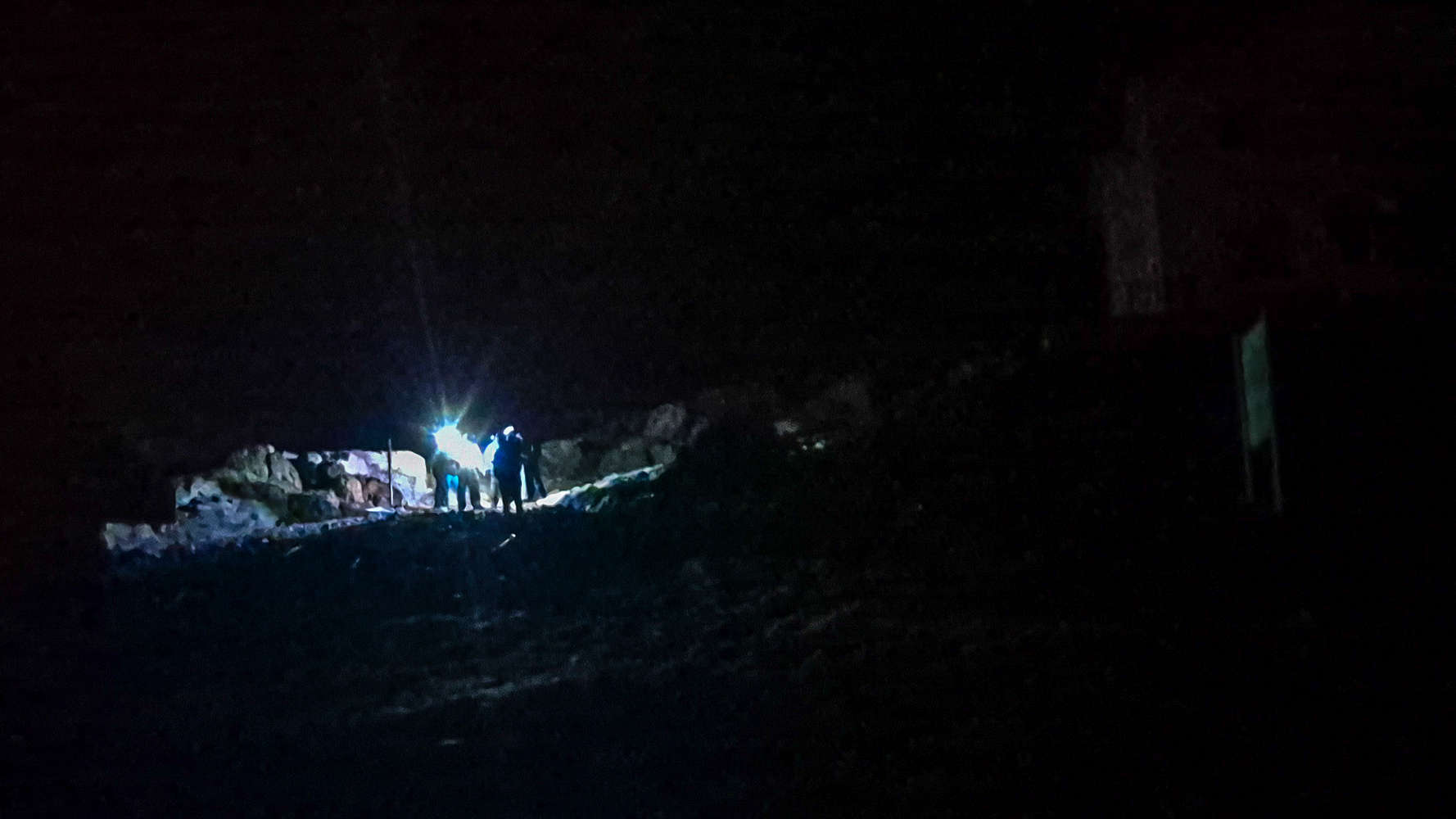
The Northern Irish team being stopped by the police.
Curious as ever I also went outside to be met with a group of 5-6 Northern Irish fellas, all getting ready to brave the weather and law on their attempt to summit. The majority of the guides also came out to see the commotion, and in the debilitating cold and rain sang songs, while Marwan and I felt stupefied by the team’s decision to proceed. Having put their crampons on, they left the refuge and only made it 100m before the police officer stationed at the hut above came out to stop them. Unable to hold our own in these conditions we went back inside to eat, talk, and relax before we left.
The Descent
We spent a long time, at least 4 hours, eating and talking at the refuge. Each of us had many reasons to want to make the summit, especially Vika who was celebrating her birthday. Ruminating quite lengthily on the reasons why any attempt on the summit could be a disaster. In some ways, the whole situation felt weirdly fitting, a failed attempt with no attempt at all, just a big fat “No” handed down from the mountain gods, and their earthly workers, the Moroccan police.

Faical, Terry, and I, leaving CAF Toubkal.
Heavy with snacks, and worsening weather on our tail, we opted to leave the refuge at the break of dawn. The Egyptians had fallen asleep, presumably hoping to make an attempt later in the day, and I was able to say goodbye only to Aija and Vika. I did make sure to greet most of the hardworking guides, and extended a heartfelt thank you to the refuge manager who is now the third generation of his family running it, and doing an amazing job at that. Before leaving Faical, Terry, and I took our only group photo.
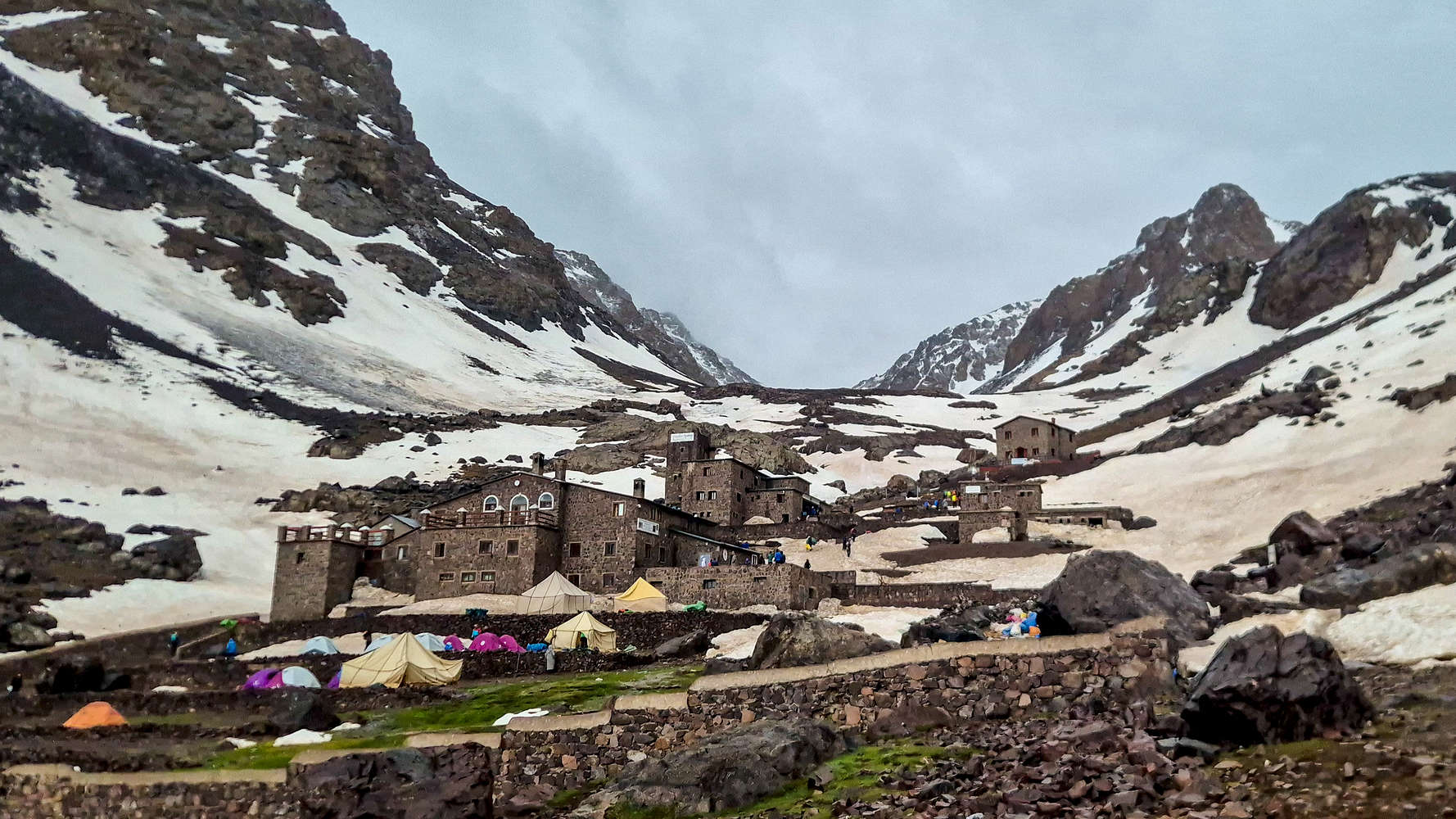
Overcast view of the Toubkal refuges.
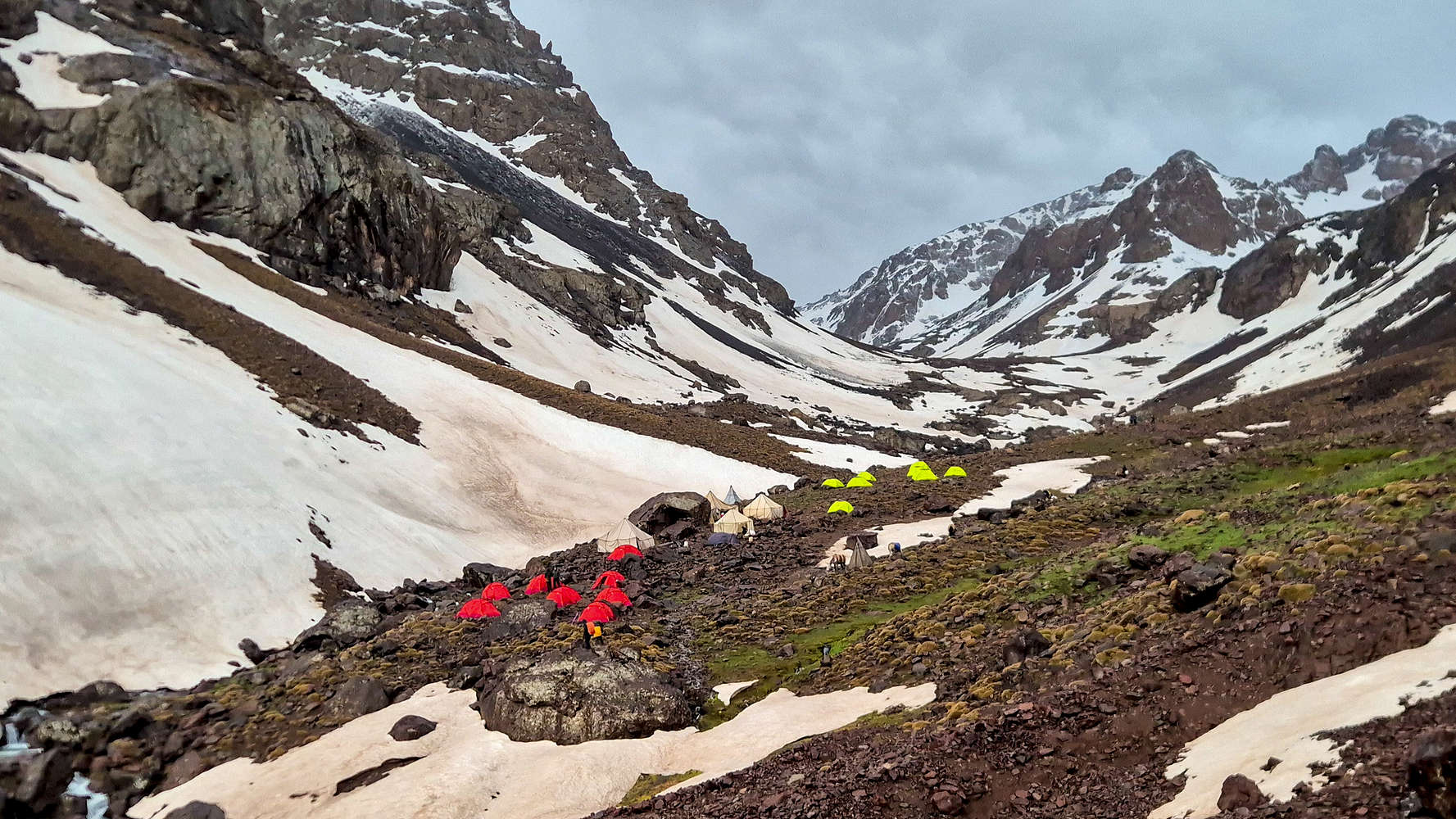
Tents pitched a few minutes from the refuges.
The ambiance on our return was completely different as the conditions remained wet, dark, and windy. We hiked in as much gear as possible to stay dry, and even then we occasionally stopped to protect ourselves from spin-drift. It was not a day for a summit. We made quick time to the last of the stalls, just 30 minutes. There we found our orange feline friend, and apparently her kitten who being separated from its mother had understandably freaked out. I kept them some company as I smoked, letting Terry and Faical continue ahead. Only one of the three Atlas Wheaters I saw the day prior could be found making the rounds.
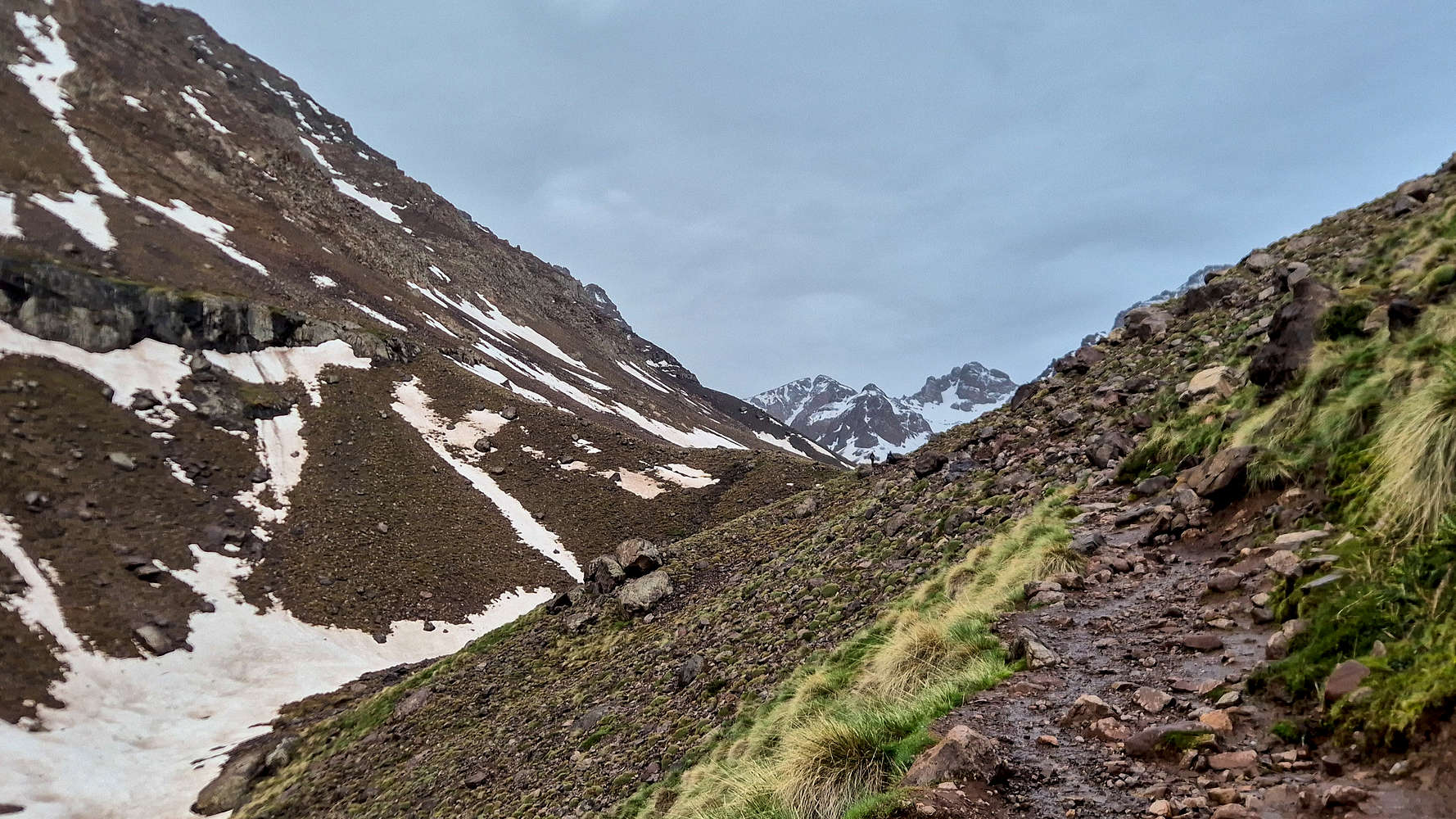
Wet conditions at the main moraine.
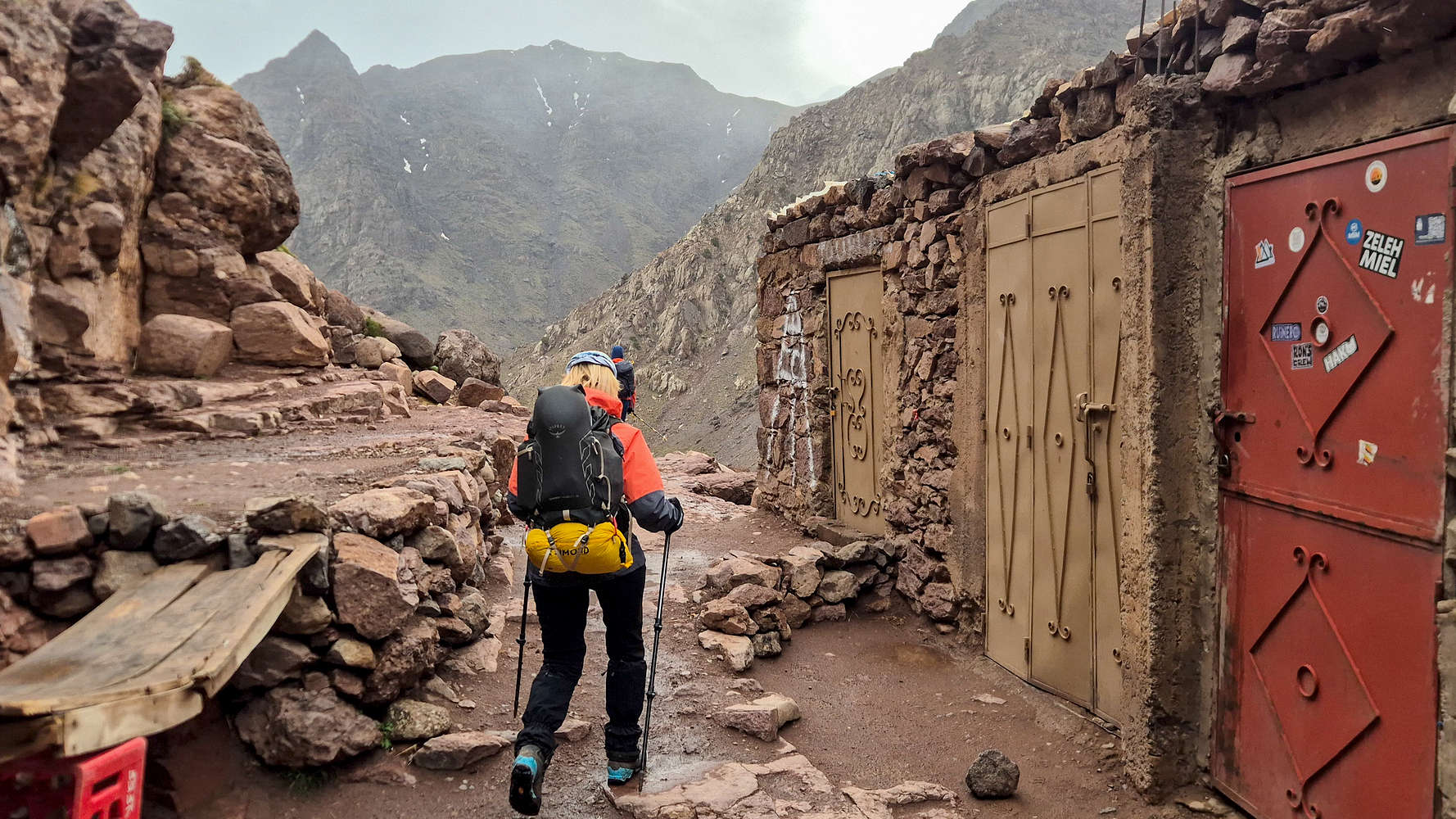
A quiet rainy morning at the pass stalls.
We continued along the familiar course. Across the valley former steep pitches of rock had turned into waterfalls and the peaks came into and out of the clouds. It was dead silent, with only a few other descending groups so early in the day. The otherwise busy shops by the outcrop were now closed. As we approached 2,500m the sun broke through the clouds giving us some much needed respite from the drabness. We descended the pass under the sun, Faical stayed behind talking to a group of French mountaineers, and I led Terry down the pass, giving myself enough opportunities to stop and observe a lone Eurasian Kestrel (Falco tinnunculus) playing with the thermals. The descent of the pass went by much smoother, and leading a group of more than 30 trekkers, we reached Sidi Chamharouch.
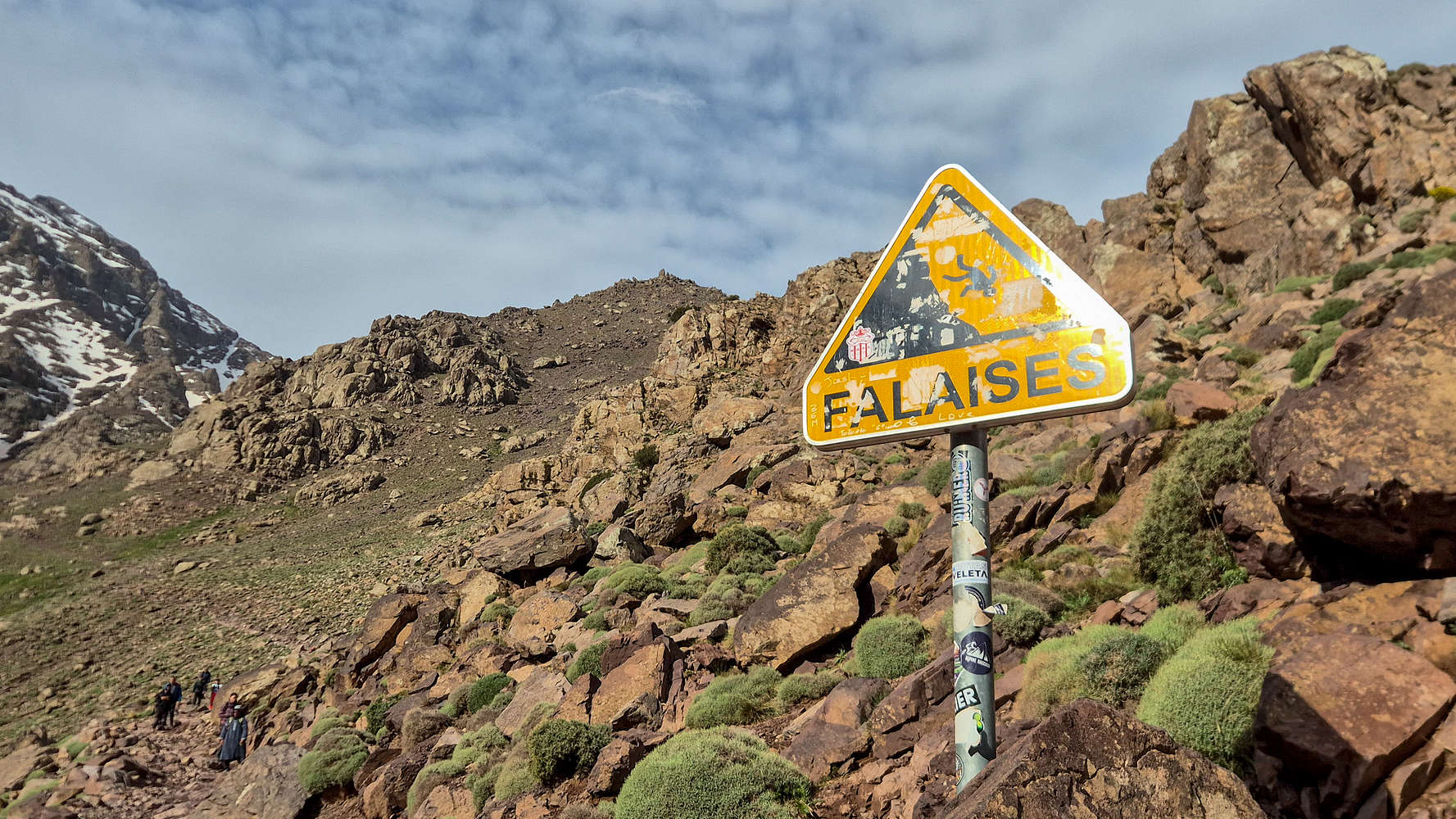
Signage at the pass.
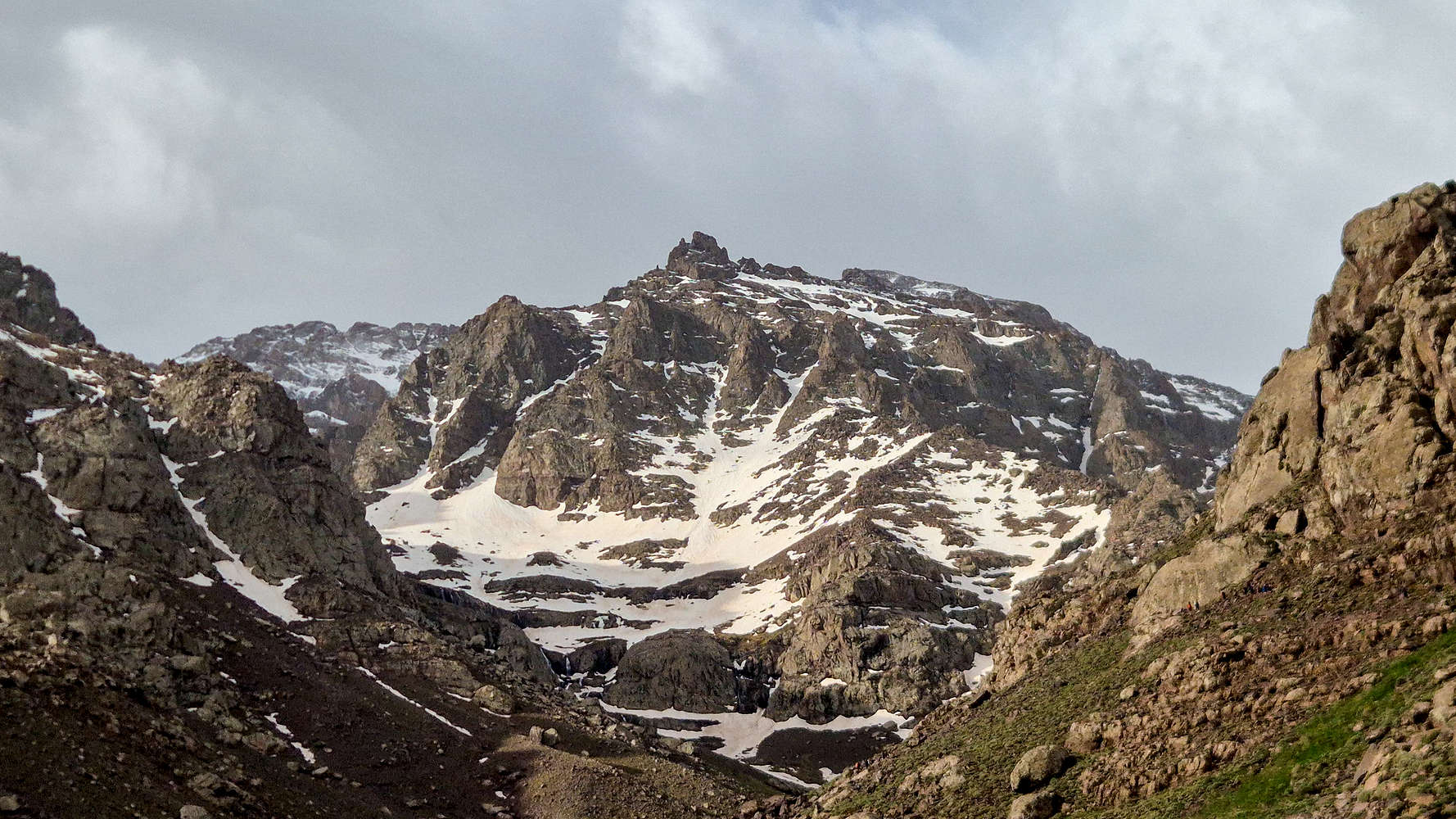
The North face of Afekhoi (3,755m).
At Sidi Chamharouch we once again sat at Cafe Boshib Brahim (2,300m) right by the river, and drank the fresh squeezed orange juice which we all so enjoyed. At Faical’s recommendation I put my feet into the freezing snow-melt ravine; a fitting sacrifice I thought: maybe next time we’ll be given easier passage. Alongside was a Grey Wagtail (Motacilla cinerea) doing the same. We didn’t stay long, in an attempt to outrun the weather but were unable to do so. We spread out as we descended and talked little, we took some photos, and individually navigated the incoming mules. It is always sad to leave the mountains.
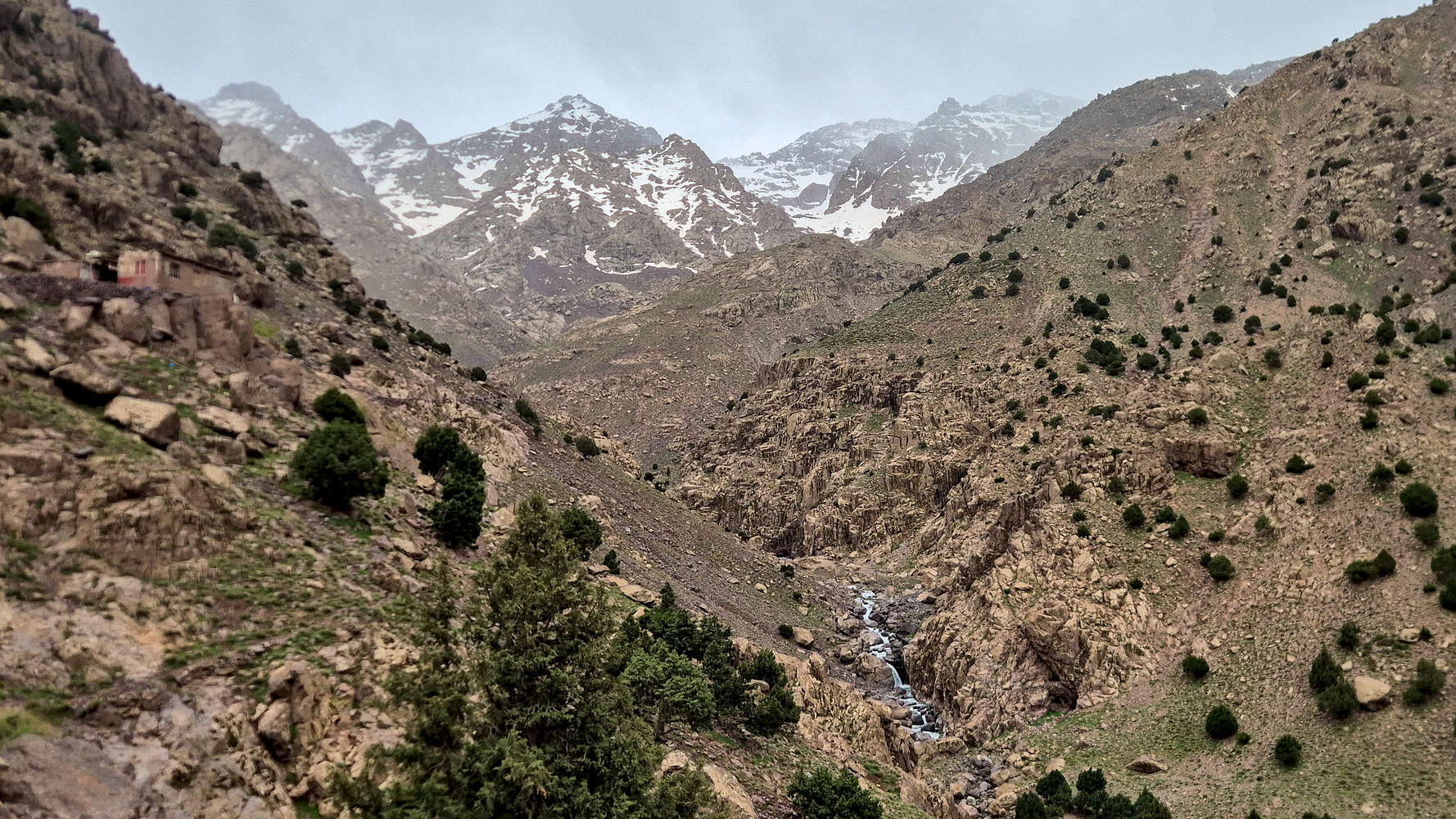
Oued Rheraya waterfalls and the Tichki (3,753m) and Afekhoi (3,755m)
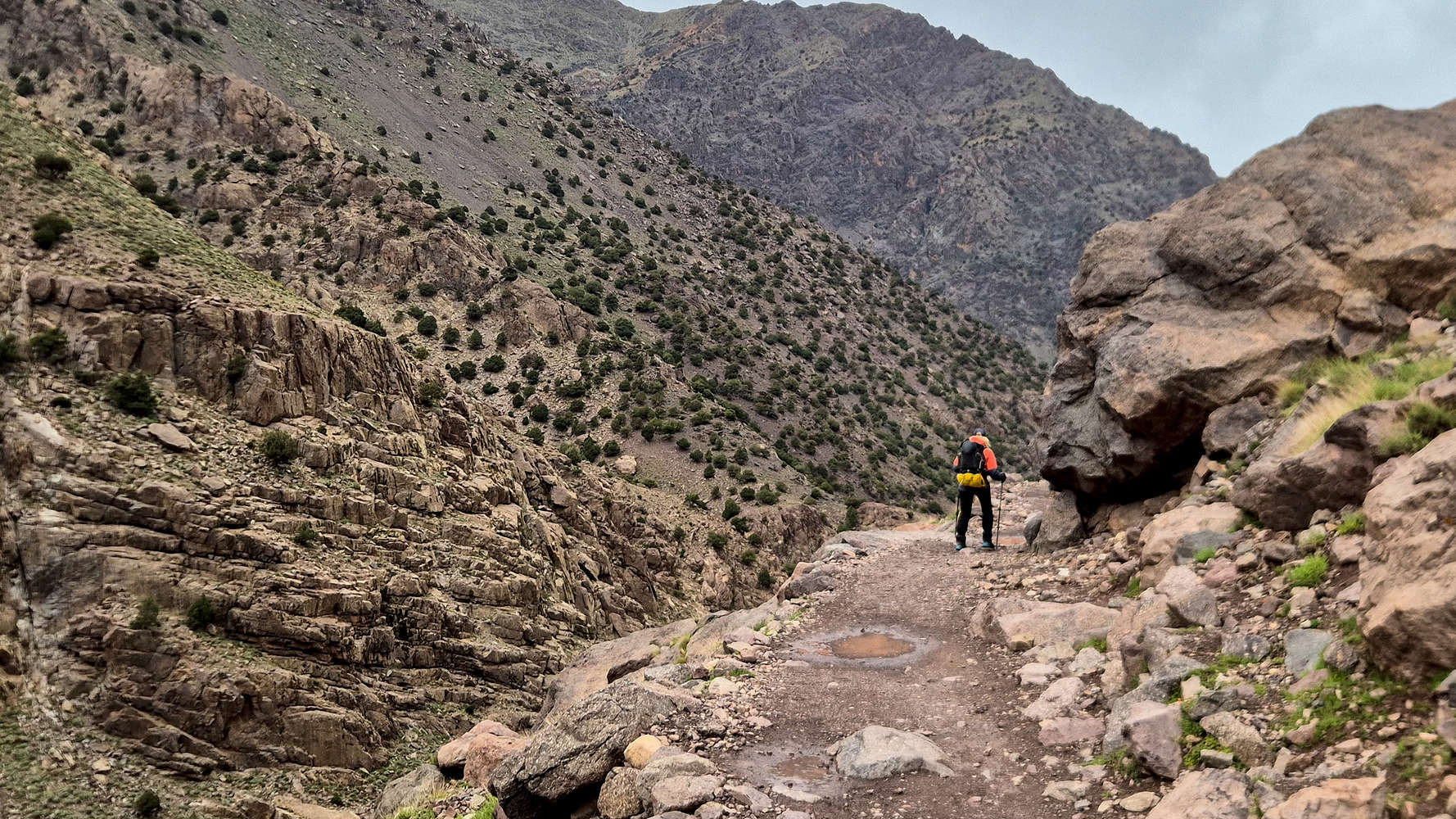
Somewhere on the lower trail.
We’d managed good time on the descent, and Terry’s knee seemed little affected, so as we approached the sub-alpine zone near the police checkpoint we slowed down. We took some photos and I walked with Faical talking. It rained sporadically, and it felt good to be at these low elevations. We hiked alongside a lush forest of Spanish Juniper (Juniperus thurifera) and some the large boulders we had spotted on the ascent. Soon we reached the floodplain of Oued Rheraya and with it now full of fresh rainwater we had to make a couple of longer river crossings. Once again we walked down the dirt road of Azib Assougolor as Faical called for a taxi for us via Omar. We sat by the bridge and I got a call for my upcoming lead climbing course in Greece, and in a few minutes we were on our way down to Imlil.
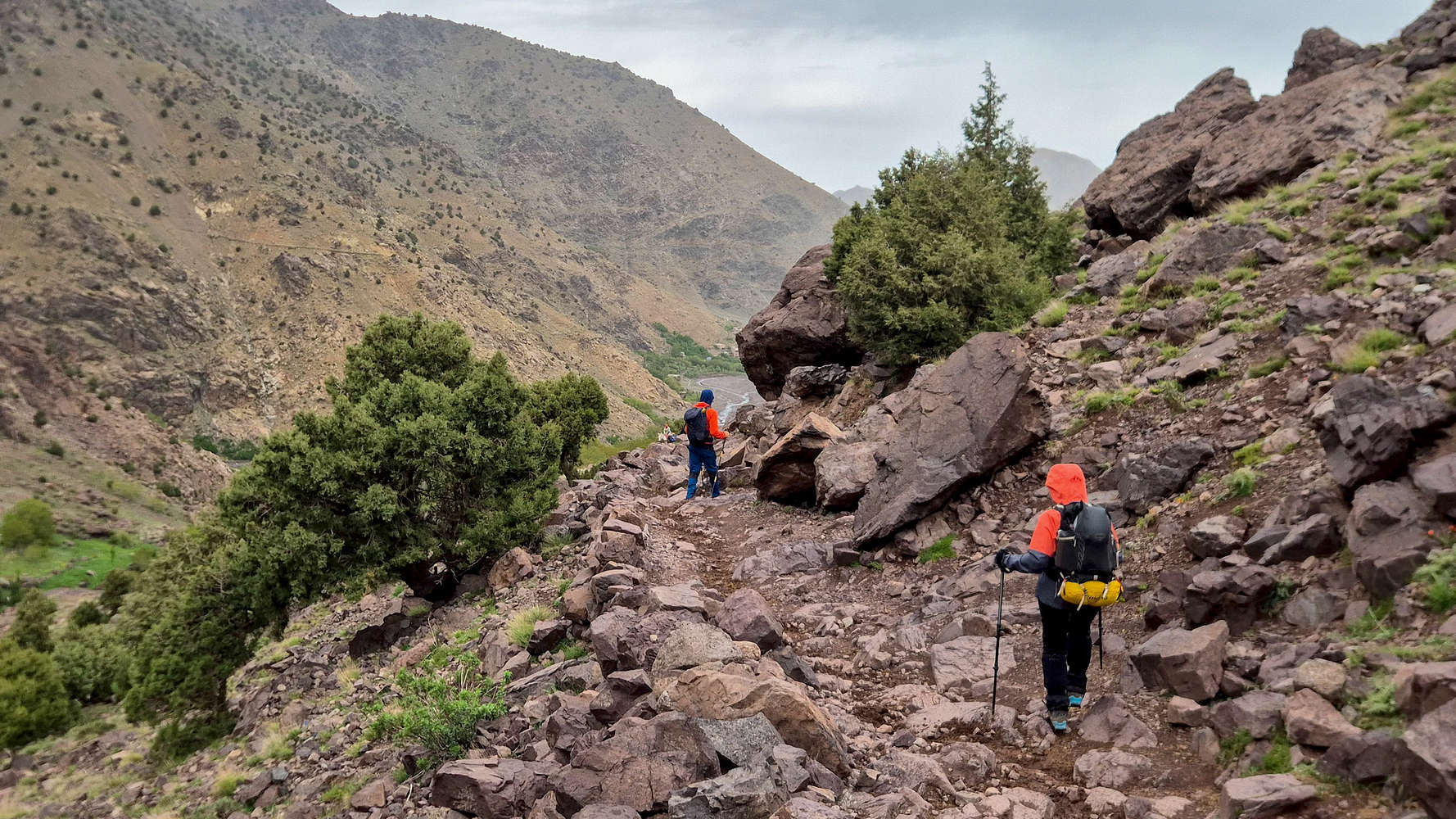
Hiking among Spanish Juniper.
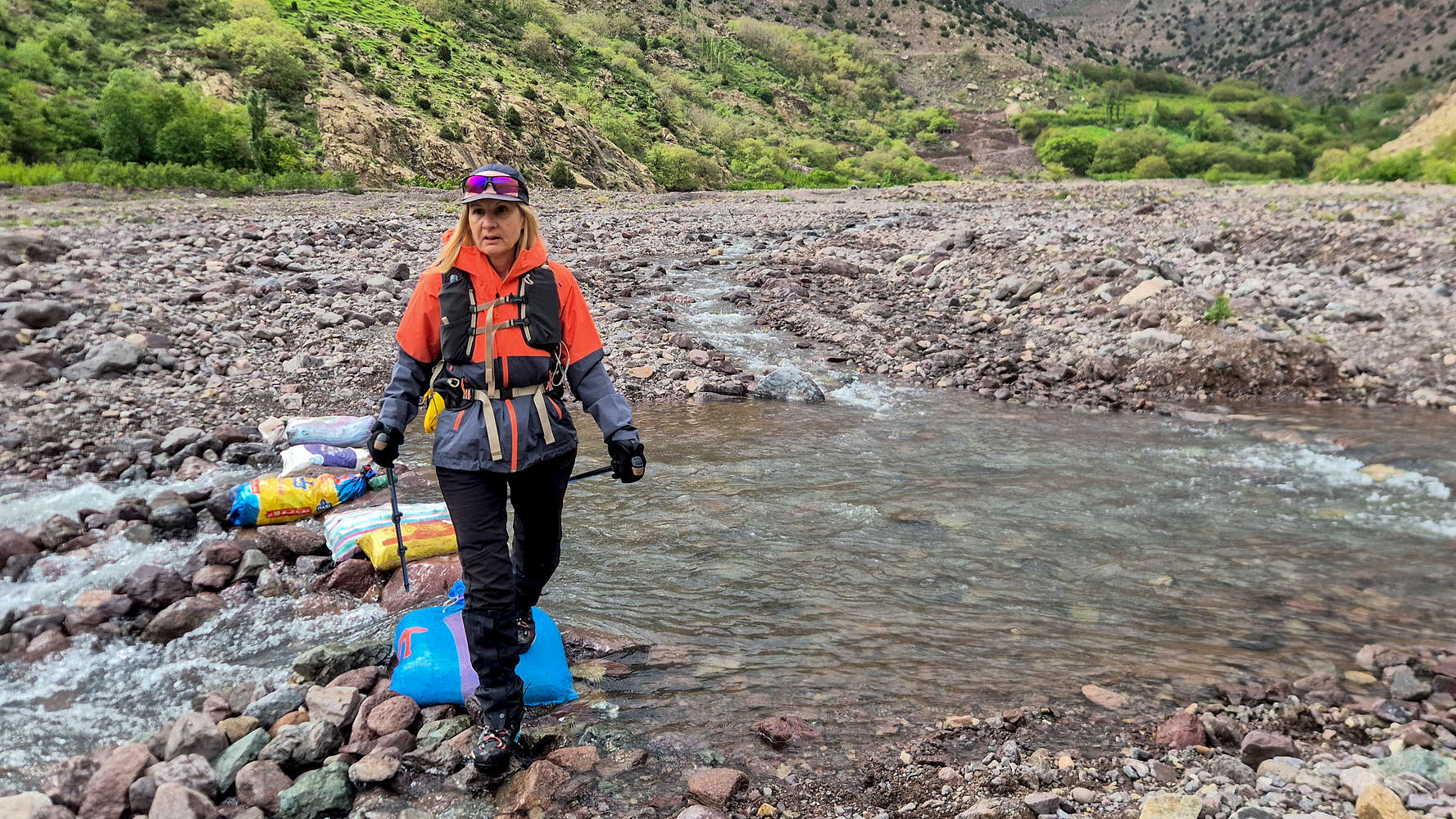
Crossing the Oued Rheraya outbound.
Imlil to Marrakesh
We were driven back to the Riad Berber Towers in Imlil where Omar had nicely agreed to let us leave our suitcases. We were offered mint tea as we changed and repacked our equipment for the drive back to Marrakesh. Curiously, I found a “Best Walks in Southern Wales” in the shared library while doing so. We spent less than an hour until Moustafa picked us up for the journey to Marrakesh. Driving off into the lower elevations we were quickly reminded of the ongoing extreme conditions as thick fog enveloped and temperature stayed as low as 10°C until Asni, this however did not seem to affect the Western Cattle-Egrets and Maghreb Magpies (Pica mauritanica) which comfortably enjoyed the various lush patches of forest along the route. Reaching Marrakesh, Faical talked with our riad and figured out the best place to drop us off, where we met with the owner Osama, and walked into the chaotic streets of the city. We shared a heartfelt goodbye.
Relaxation in the Medina
The short walk through busy main souk streets and then little narrow passages, even with Osama as our guide, was a bit of a harsh landing into the realities of Marrakesh. After being welcomed into the Riad Dar Ourika we were shown to our rooms, and waited for our planned Hammam; I spent an hour on the rooftop, taking in the expansive views of the Medina. Our Hammam proved to be a pleasant experience after the hike and we both felt rather refreshed and energized. We did however, take a couple more hours of rooftop rest, with incidental afternoon birdwatching which yielded spots such as the Common Bulbul (Pycnonotus barbatus) and House Bunting (Emberiza sahari).
The Medina quarter of Marrakesh is designated as a UNESCO World Heritage site.
A Walk in Marrakesh
Feeling much better, but already awake for over 12 hours, we decided to take our first walk in Marrakesh, with the cool offering the most pleasant of conditions for doing so. Equipped with an annotated map from Osama, we instantly got lost. The busy souks of Marrakesh were maddeningly difficult to navigate, but without obligations or plans we simply kept walking. Eventually getting our bearing we exited onto Jemaa el-Fnaa (ساحة جامع الفناء), with its hundreds of stalls, street sellers, and certain questionable practices such as the dancing cobras and chained monkeys which can only be described as cruel and designed to perpetuate the orientalist expectations of western tourists. Without wanting to stress myself over this, I had us walk across to the nearby Kutubiyya Mosque (جامع الكتبية), the largest in the city.
Jemaa el-Fnaa was once the terminus for desert caravans making their way across the Sahara and as far south as Mauritania.

The Kutubiyya mosque with its 77m minaret.
The minaret from Kutubiyya gardens.
The mosque, originally built in 1147 is certainly a breathtaking structure. Its intricate carved facade feeling nearly alive as thousands of holes and crevices serve as homes for the Common Swift (Apus apus) and Common Wood Pigeons (Columba palumbus) which roam the city. Its name means the “bookseller [mosque]” which is derived from the trade of the nearby souks, it was thus, rather fitting that a book festival was taking place. We continued walking out of the Medina and towards the nearby Kutubiyya gardens. We took some solace in the peaceful nature and fewer tourists, admiring the beautiful fountains and view of the mosque. Being out for over an hour we retraced our steps back into the Souks.
Dinner
We had a lovely Tagine dinner with assorted local and homemade starters at the riad and I spent most of the evening upstairs, enjoying the lights of the city and the sounds of Tuareg blues musicians Tissilawen. The riad cat Lindou, who also hung out with us during dinner, kept me company and was rewarded with some beef jerky for it. I saw Marrakesh go to sleep and reveled in the silence that overcame this wonderous city; I had been awake for over 24 hours.
Day 4: Marrakesh
Sleep is overrated when you are in a new city for just one day, so by 08:00 I was already on the rooftop, enjoying a morning cigarette alongside the orchestra of morning birds. We had an exceptional breakfast with some really good handmade yoghurt and both felt rather rested. It was time to explore Marrakesh!

A sunny morning in Marrakesh.
Madrasa ben Youssef
Our first visit of the day would be to the Madrasa ben Youssef (مدرسة ابن يوسف), the qur'anic school built during the 16th century near the old Ben Youssef Mosque, which is recognized as the pinnacle of Saadian architecture. The madrasa (college) features a rectangular layout with a central courtyard with a reflecting pool, and student dormitories built around it on the above levels. The courtyard and corridors are intricately decorated with zellij (mosaic tilework) and carved stucco and wood. The extremely long line waiting for us outside went by surprisingly quick, and besides the narrow but busy corridors, the madrasa was of exceptional cultural, historical, and architectural interest.

The madrasa courtyard and reflecting pool.

Intricate wood carvings in the madrasa courtyard.
Besides the crowded hallways, the early morning was a good time to make the visit with plenty of opportunities to explore the madrasa, take in the architecture, and snap photos.
Medina Souks
Leaving the madrasa we took an arcing roundabout walk, across less touristy streets and souks. We also got into the rhythm of the main tourist activity in the city: shopping. Every once in a while, an interesting shop would pique our attention, and usually something was purchased, a scarf, some argan oil, and a collection of 10 postcards for Nieve. We walked aimlessly. I found a stall with fossils and minerals, clearly hand picked. I struck up a conversation with the guy and was shown some exceptional crystals, but keeping myself on a budget bought only a Desert Rose, and Aragonite. I was however tempted by the giant Ammonites!

Large Ammonites are very common.

A quieter souk scene.
The pace of the souks can be intimidating, but at least for us things quickly got very easy since with a mix of French, Arabic, and English we were able to perfectly communicate, and being Greek certainly had its upsides. We didn’t run into many Greeks in Marrakesh besides some girls who told us they were spending the entire week in Marrakesh; for shopping of course!
Museum of Mouassine Music
Our winding course eventually led us to the Museum of Mouassine Music. Hosted within an incredible 15th century manor house with a guest-welcoming apartment (douiria) and Almoravid-era grain-silos, nestled in the back streets of the center. It hosts a great collection of African and Moroccan instruments and objects. In exhibiting the wide range of music influenced through human migration and slave trade routes which coexist in Morocco, the museum provides a wholistic understanding of the true multiculturalism of the country. Across the museum rooms are dedicated to root musical practices in the sub-Sahara, the derived musical genres of Morocco, and the influence of Islamic faith, and Arabic and Jewish music. The ticket for the Museum of Mouassine Music also includes entrance to the House of Photography.
The building was inhabited by modernist Moroccan painter Abdelhay Mellakh (b. 1947), with his works being featured in the upstairs area. It was later restored with the help of Xavier Salomon, curator at the Louvre Museum.
When purchasing our tickets that Saturday, we were informed of the scheduled Gnawa traditional music concert taking place that afternoon. We couldn’t resist buying tickets. Knowing Vika was in Marrakesh for a few days I texted her about it and she agreed to join us; I assumed the Egyptians had already flown out that morning.
Lunch with Friends
But it seemed I was very wrong because, as we walked towards our booked lunch at Le Jardin Ben Youssef (⭐4.5 | +400 ), we simply ran into Marwan and Sofia. A quick discussion revealed their flights were later that day and they were hungry with no plans for lunch. The more the merrier we thought and asked them to join us on our reservation.
We shared a lovely spread of delicacies including octopus, lamb, salad, humus, and probably other equally scrumptious options. They told us all about their failed attempt, starting from CAF at 08:00, and during which they only ascended about 300m in terrible conditions of spin-drift, ice, and destabilizing winds over 3 hours, then having to sleep in Aroumd. We moved on to other topics and dragged out our lunch feeling content. We invited Marwan and Sofia to the Gnawa concert later that evening and they agreed to join.
Gnawa Concert
The day had ticked away, and by the time I walked Terry back to the riad I was soon supposed to meet Vika nearby. Luckily I was there early, and walked her to the riad for some rooftop views before Terry joined us and we left for the concert. It was lovely to see the Egyptians had actually joined.

The Gnawa concert at the Museum of Mouassine Music.
The evening would involve a concert of Gnawa music, a musical genre of the Malian slaves who were brough to Morocco (see: Black Guard) and which is classified as a UNESCO Intangible Cultural Heritage. Gnawa is a deeply mystical tradition which is in part artistic expression and healing ritual. A Gnawa liturgy is led by a maâlem (master musician) and a shuwafa (clairvoyant), and is believed to be able to cleanse the congregants; with those being healed often being described as entering a trance state. According to legend, the Sintir - the Gnawa traditional bass - is a communal and occult vessel, which must be constructed in a specific manner using animals sacrificed on particular days, and is said to be able to contain the malevolent spirits (djinn) of the ones it heals. In this way it can only be safely cleaned or repaired on a Friday.
Gnawa music is very interesting and particularly modern, with the Sintir playing a pivotal role in the musical structure. There is accompanying percussion provided by finger-cymbals and the rhythms are often fast and dynamic, perfect for the use of polyphonic call-response. From a musical point of view, it features a compelling combination of fast bass and procession with a purely traditional approach to signing and retaining the call-response elements.
During the concert a slight rain began which would go on to last all evening, and with me having a fleece I offered my waterproof to Vika. Thus, following the post-concert rooftop tea, where we got to talk to the musicians, I agreed to go with her to her hotel to pick up her own waterproof jacket. We walked to the outskirts of the Medina where the imprint of tourism is much smaller, and the streets less catered to the western gaze. I was shown travel photos from South Africa for an hour until we decided to walk back into the center, and to our respective dinners. The rain had gotten much worse, and as a result the streets were practically empty.
Dinner at Le Trou Au Mur
For our last night Terry had already booked a table at Le Trou Au Mur (⭐4.6 | +800), one of the best spots in the Medina. Although featuring a beautiful terrace, we had to dine inside the beautiful hall due to the rain. Nonetheless, we very much enjoyed our dinner, ordering lamb, fish, salad, and also a bottle of wine. The large portions took a while to arrive but gave us enough time to take stock of the events of the last few days. Everything was very good and the meat main of lamb was particularly flavorful. We finished dinner around midnight and walked through the now desolate and wet streets of the Medina. We wasted no time in packing and going to bed.
Day 5: Departure
I woke up at 07:00 looking to take advantage of some extra time. Very soon, I was informed by Terry that she had been sick since late last night. Was it perhaps the fish at Le Trou Au Mur, unlikely. It did not matter as she needed some anti-emetics, and it was my job to go get them. Before doing so, I took a couple of minutes to wake up at the terrace, and was welcomed with an exceptional sight, the High Atlas sprawled across the horizon were blank white; it had snowed!
Pharmacy Run
Most pharmacies in Marrakesh open at 09:00, and only one on Google Maps seemed to be open 24-hours. Finishing my cigarette I bolted to the curious back street that this pharmacy seemed to be located in. Turn after turn I exited the touristy Medina and found myself all alone in back-alleys. Reaching the intended destination, I found nothing, and walked back to the hotel defeated, looking to wait until 09:00, with our scheduled pick up at 09:30.

Lindou enjoying the morning sun.
After a short break I went back out, and at 08:55 was outside an actual pharmacy. The pharmacist was a little late but it was all fine since I left with a box of medicines for only €3. I also made it back on time to deliver the medications, sort my bags, pet Lindou, and sort out some help from the hotel receptionist. We had already arranged with Moustafa to drive us to the airport, not realizing that he drove all the way from Imlil to do so. We met him at Place Larousse where he had dropped us off only a few days earlier.
Marrakesh Airport
We made it to the airport some 3 hours before our flight and had no problems checking in and clearing security. Terry found a spot to sleep her sickness away while I did some last minute shopping to get rid of our remaining Dirhams. The two Greek girls we met in the Medina were on our flight and getting to talking I learned that as interior designers they had visited Marrakesh to buy some decorations and rugs. I couldn’t help but do the same, buying myself a ceramic ashtray.

Outside of Marrakesh Menara Airport.
Epilogue
Writing this more than a month after the events and having time to process the whole experience, I feel more compelled than ever to revisit Morocco. The memory of the trip feels surprisingly vivid and energized spurred perhaps by the involvement of other people in the endeavor. I have nothing but admiration for everyone I met in Morocco, including most of all the hardworking porters, guides, and the mules which fuel the mountain economy. The government has also done a lot to ensure tourists feel safe in the country, with checkpoints, and controls all aimed at improving the experience; yet as we mentioned some things may skew too far that way. Moroccan hospitality, cuisine, and attitudes felt homely to us and we have nothing but good things to say about our visit, and hopefully we’ll be able to make the trip again soon. A thank you must be extended to Omar, the owner of Riad Berber Towers in Imlil, Mustafa the lovely taxi driver, and Osama the owner of Riad Dar Ourika in Marrakesh. Most of all a heartfelt thank you should be extended to Faical.
In the month which followed, we returned home and focused on our next projects. Faical waved goodbye to the winter season with some Alpine climbs before heading South and onto pure rock for the summer. We were able to exchange some emails and he very much enjoyed the Greek delicacies we gave him. Vika stayed in Morocco for another month, and was able to return and summit Jbel Toubkal (4,167m) on the 31st of May 2026, in summer conditions. Aija also stayed in Morocco but only for a couple of weeks, and did not return to the Atlas. Marwan and Sofia have already been planning their next visit to the Isougouane valley, perhaps this autumn. As for us, we may return to Toubkal in an attempt to summit the 8 x 4,000m peaks of the massif, but until then hopefully Faical will have been able to visit Greece as well.
Tell my friend, that this world is harsh
Without solid foundations and lofty goals
One is lost in its storms
The soft sounds of Tuareg blue’s artists Tissilawen come to mind when I think of my time in Morocco, and I know that the people I met along the way would espouse by the above line of their hit Amidinine.
Logistics
This trip has been perhaps the most logistically complex to date, requiring planning of all off-mountain stages, such as flights, transfers, hotels, and of course finding a guide. We made a great organizational effort which luckily paid off.
Faical — Atlas Guiding
We were able to collaborate with alpinist Faical Bourkiba for our visit to the High Atlas. Faical is a highly experienced mountain guide and climber who does not often work the normal Toubkal route. We recommend getting in touch with Faical if you are looking for more complex mountain experiences in Morocco such as Alpine climbing, Ice climbing, and Big Wall rock climbing.
It was a real pleasure to spend time with Faical for whom I have nothing negative to say. He offered us the perfect mountain guiding experience, and even made sure we were alright during our arrival and after our visit. I am glad I got to hike with him and would not pass up an opportunity to do it again.
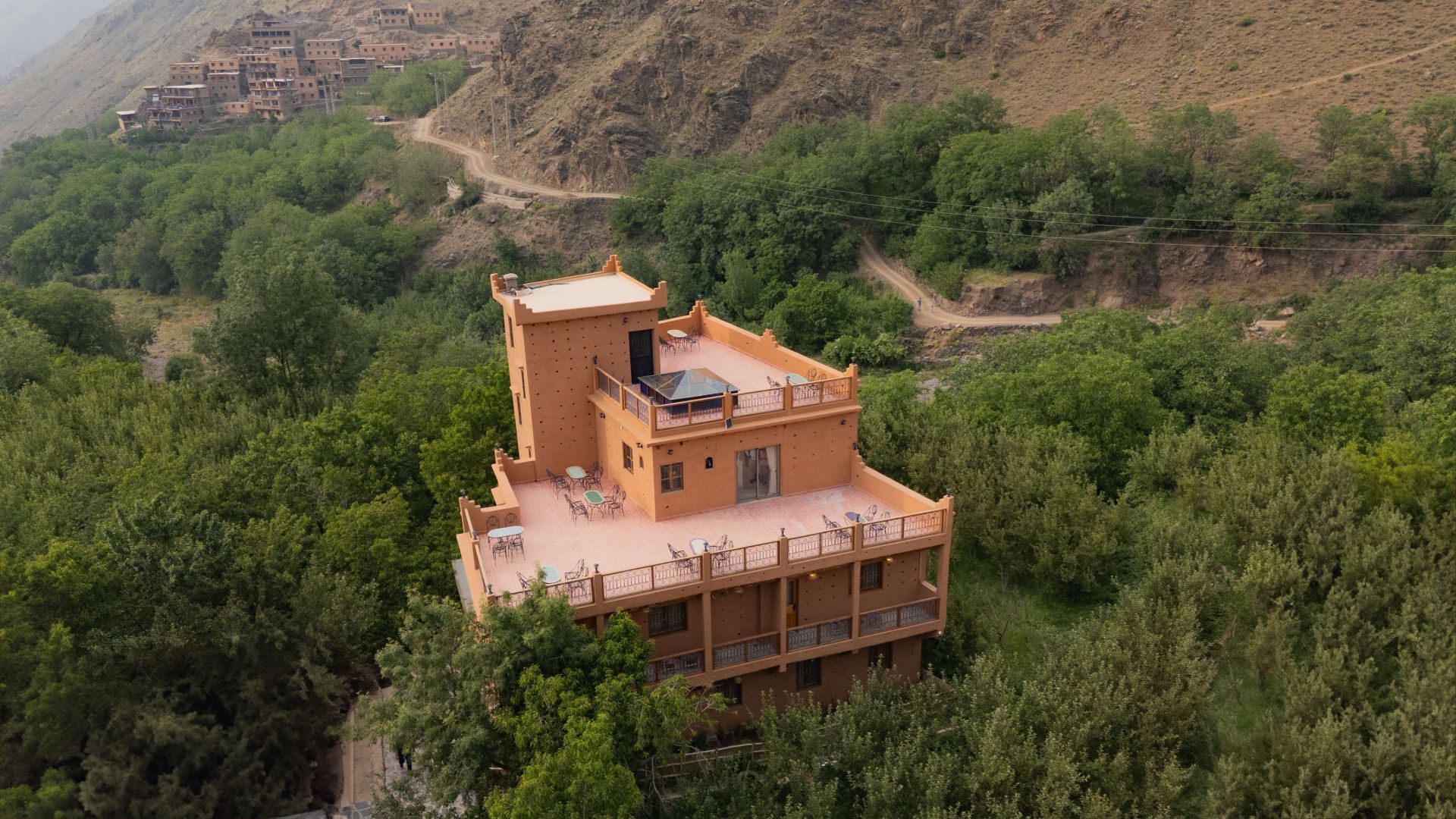
Riad Berber Towers
Riad Berber Towers (⭐4.9 | +50) is an exceptional family-ran newbuilt riad in Imlil that is beautifully appointed and offers great value. The riad is situated low in central Imlil so can be a little harder to access the trailhead, however, the spacious rooms, beautiful decor, and quant outside area make up for all this. The food served, including both breakfast and dinner was exceptional and clearly home made. Omar, a mountaineer himself, was a gracious host and not only drove us to the trailhead but let us store our gear until our return. If ever in Imlil we will definitely stay here again.
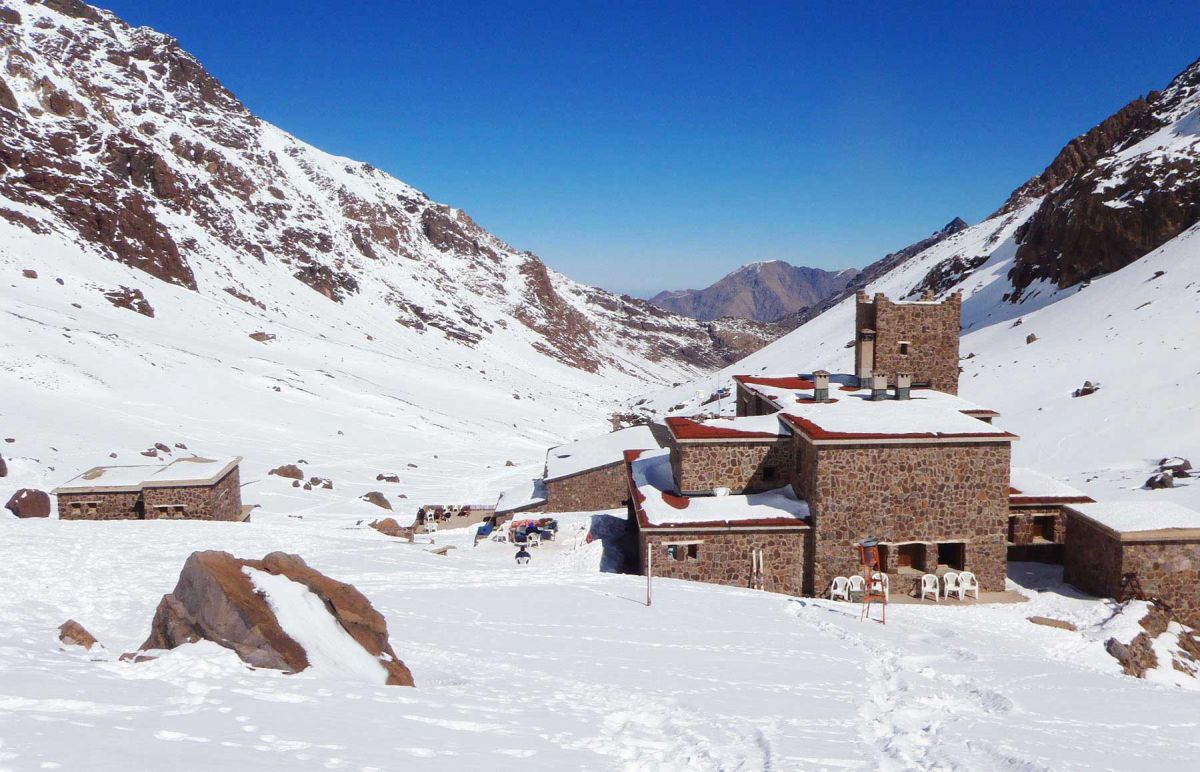
CAF Refuge du Toubkal
The CAF Refuge du Toubkal (⭐4.0 | +700) at 3,207m often gets a bad reputation, as most high altitude refuges, however, I must say it is a lot better than we expected. The refuge interior common spaces are all well equipped, there is electricity, and plenty of sitting space, as well as a large shop, and gear storage area. The dorms themselves are also more than adequate and besides the heat, even at 1.5x occupancy our dorm felt spacious. The refuge was also exceptionally clean, and the staff made a continuous effort to keep it that way in all commo rooms. Same goes with the bathrooms which were literally spotless when we first got there. The kitchen service can be imperfect - e.g. we got some half boiled water - but the lunch and dinners we had were both of great quality and rather appetizing. It is certainly a non issue to stay here for 1-2 nights since all expected luxuries are afforded. More extended stays, necessitating showers, may be more complex.
Riad Dar Ourika
Riad Dar Ourika (⭐4.4 | +200) in the Marrakesh Medina offers a good value proposition with great amenities. Little more can be said about the amazing rooftop of the riad on which I spent most of the stay. The food, and especially the breakfast were highlights of our stay, as is the general ambiance of the interior spaces. The quality of our admittedly cheaper room was alright, and while it was large and clean, it showed some signs of wear. Given however how little time we spent in there it was not a problem. In my opinion this riad deserves extra points on account of Lindou who is very well kept, clean, friendly, soft, and sociable. The location is also worth noting, and although not recommended to those who are navigationally challenged, it can be the perfect jumping off point for a day in the Medina. Osama was also a lovely and very helpful host.
Transfers
We opted for transfers since renting a car would not be useful. We pre-booked only the one-way taxi from Marrakesh Menara Airport to Imlil, which we did so using Booking.com. Besides being a little late, the ride was fine and the cost reasonable. The rest of the transfers were booked through Faical and Omar in Imlil. Moutstafa, the driver Omar got for us for our Imlil to Marrakesh journey offered to drive us to the airport, which we organized ourselves the old fashioned way; and paid in cash.